

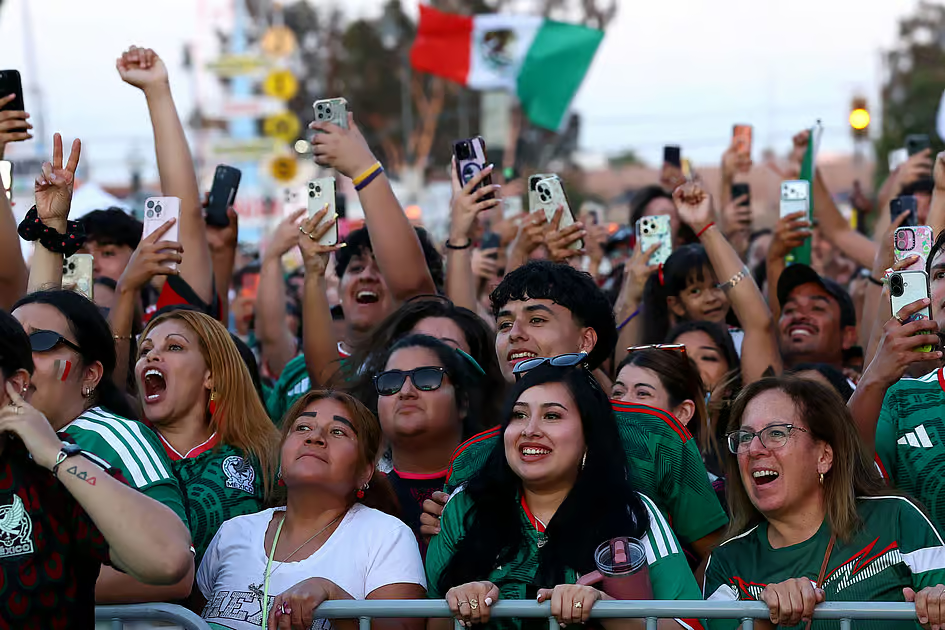
According to FIFA Media, Tuesday’s Mexico vs South Korea match averaged 25.5 million viewers in Mexico, making it the most-watched World Cup broadcast in the 21st century.
At first glance, it may seem surprising that a group match against South Korea attracted a larger audience than many of Mexico’s traditional rivalries, but the history between them is remarkable.
The bond between both countries started in the 2018 FIFA World Cup in Russia. Heading into the final round, Mexico needed to avoid elimination, Sweden needed a win to advance, and Germany, the defending world champion, simply had to defeat South Korea. Since South Korea had already been eliminated, many expected an easy game, assuming they would not be fully motivated to compete.
The outcome seemed obvious. Germany would defeat South Korea and advance. Instead, South Korea defeated Germany 2-0 in a major upset as the Germans failed to reach the knockout rounds in a World Cup for the first time since 1938.
Since Mexico was down 0-3 against Sweden with less than 10 minutes left, most Mexican fans started to watch the Germany match, which was tied at 0-0. Then South Korea turned the tables and won 2-0, advancing both Sweden and Mexico. It earned nothing but applause from the Mexico team.
This may seem like a normal game, but it’s not, as for many Mexican fans the debt has never been forgotten.
It developed into something more. They showed appreciation whenever South Korea appeared on the international football stage. What started as gratitude because South Korea helped them turned into a genuine football friendship.
Despite facing each other on the field, Mexico and South Korea celebrated together in host cities and fan zones. Many videos were trending online of them singing together, dancing to both Mexican and K-pop music, and sharing pure joy from both communities. Someone described it as, “A carnival atmosphere unlike anything else at the tournament.”
It might be the start of something new, something permanent, like how Australia and New Zealand are connected.
A Korean-American shared their experience following the match:
“Without even really caring much for football, I’m being thanked on the streets by my Hispanic neighbours because I’m Korean.”
He noted that Korea-town has often experienced social tensions, cultural divisions, and debates over immigration, identity, and gentrification. Yet for a brief moment, a football match created a shared celebration that crossed those boundaries.
“Something like a football match in the group stage of the World Cup can bring people who are usually divided together for a joyful purpose.”
Even Major League Soccer clubs have embraced the connection. Los Angeles FC promoted its Mexico vs South Korea watch party with the slogan:
“Two cultures, one city.”
The appreciation has never really faded. Years after South Korea’s victory over Germany, many Mexican supporters still view that match as one of the most memorable moments in their World Cup history.
The result created one of the most unique friendships in international sport, a bond strong enough to turn a Mexico vs South Korea match into the most-watched World Cup broadcast in modern Mexican history.
Source: Khaleej Times