

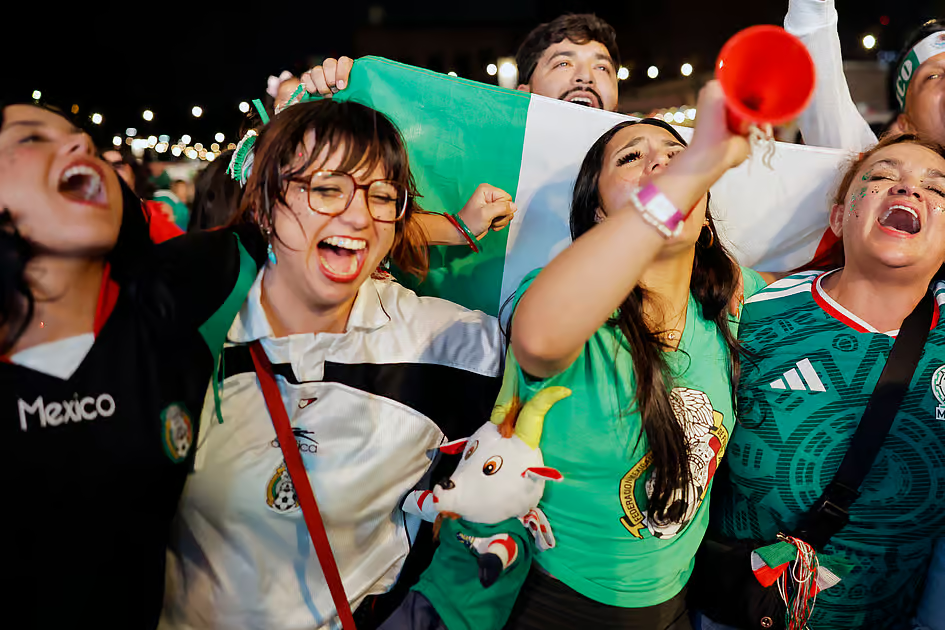
It was the battle before the war. Less than 17 hours before the round of 32 World Cup clash between co-host Mexico and Ecuador, home fans gathered outside the Ecuadorian team hotel to disturb the sleep of the opponents.
Play and predict your Fifa World Cup 2026 champion here
In the viral videos, fans are seen using loudspeakers, horns and revving motorcycles from midnight to the early hours in an attempt to rob Ecuador’s football team of a peaceful night.
Miffed by the behaviour of the home supporters, the Ecuadorian Football Federation (FEF) filed a complaint with the organisers.
“Such conduct stands in stark contrast to the principles of fair play, equity, and unity that a World Cup should embody,” the federation said.
“The FEF respectfully calls upon the competent authorities to pay greater attention to these events and to adopt the necessary measures to safeguard the safety of our players, coaching staff, and fans.”
Ecuador went on to lose the match 2-0 to a vastly superior Mexico team on the field, but the hotel incident added another chapter to a polarising chapter of football in Latin America.
For several decades now, it has become a tradition for home supporters to serenade the hotel of the rival team before big matches both at the international level and club level.
In a moving tribute to the game on the Players’ Tribune, Angel di Maria wrote how Brazilian fans did everything in their power to disturb the Argentinian team one night before the final of the 2014 World Cup between Argentina and Germany in Rio.
Having suffered a catastrophic 7-1 defeat to Germany in the semifinal, the football-mad Brazil fell into a collective depression.
In that moment of national football crisis, the last thing Brazil fans wanted was to see bitter rivals Argentina winning the World Cup in Rio de Janeiro.
Hundreds of fans gathered outside the Argentina hotel at night, making noise and setting off fireworks to disturb the team.
“I had not slept much the night before. Part of the reason was that the Brazilian fans were setting off huge fireworks outside of our hotel all night long,” Di Maria wrote.
Argentina showed no signs of ill effects from the night as they put up a valiant fight against Germany, the best team of the tournament, before going down to a late goal in extra time from Mario Gotze.
But it was just another episode of the psychological football warfare in South America.
The most shocking fan incident took place in November, 2001.
Hundreds of Uruguay fans turned up at the international airport in Montevideo to intimidate the Australian team that had arrived in the Uruguayan capital for a make-or-break World Cup qualifying match.
The fans reportedly screamed in the faces of the players, some even spat on them, and one fan even threw a punch at one of the Australian stars.
Having lost the first leg of the inter-continental playoff 1-0 in Melbourne, the Uruguayan fans were on edge by the time the Australians arrived on their soil for the second leg.
The airport incident even sparked a diplomatic row between the two countries.
On the field, the fans turned up the heat again on the visiting team, with every touch from the Australians drawing a cacophony of jeers from the crowd.
Australia eventually succumbed to a 3-0 defeat in that hostile atmosphere at Estadio Centenario as Uruguay booked their place in the 2002 World Cup in South Korea and Japan.
Remarkably, the first-ever World Cup final in 1930 was also hosted at Estadio Centenario between fierce rivals Uruguay and Argentina.
John Langenus, the Belgian referee, asked for protection from the authorities as he feared a defeat for the home team would lead to violent scenes in and around the stadium.
Fortunately for Langenus, the home team won the ill-tempered clash 4-2, becoming the first world champion in history.
But intimidation and psychological warfare have continued to haunt the purists, adding a layer of mystique to football in Latin America where rivalries sometimes turn violent and deadly.
Source: Khaleej Times