

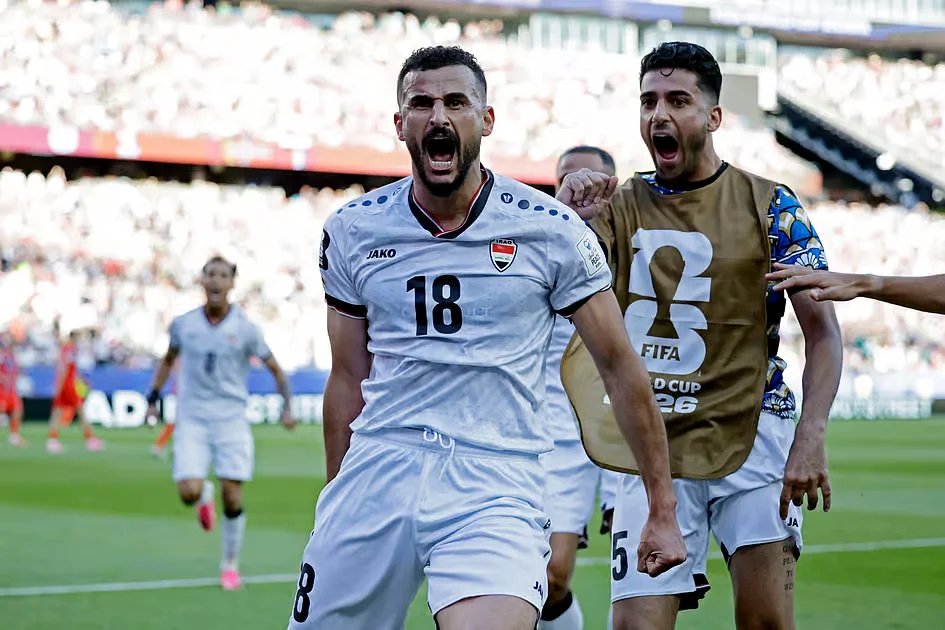
Barely 24 hours after Iraqi striker Aymen Hussein was detained and questioned by officials at Chicago O’Hare Airport after his arrival for the World Cup, pictures of the Norway national team’s photoshoot went viral.
Play and predict your Fifa World Cup 2026 champion here
Erling Haaland and Martin Odegaard, the two Premier League superstars of Norway — Iraq’s Group I opponents — posed in Viking costumes, holding weapons and shields, with a majestic Norwegian fjord in the background.
Back in the World Cup after 30 years, the Scandinavians released a statement of intent with those images — that they would bring the famous Viking spirit to football’s biggest battleground.
A dark horse in North America, Norway proved its credentials on Tuesday night by dismantling Hussein’s Iraq 4-1 as Haaland scored a brace.
His team may have fallen to the Norwegians in the opening game, but Hussein will look back on the night with a sense of pride — given all the challenges he had to overcome to reach this stage.
The 30-year-old striker scored the only goal for Iraq, an equaliser in the 39th minute after Haaland’s opener 10 minutes earlier.
Norway eventually put daylight between them and Iraq on the back of their superior all-round players who enthralled their country’s fans — many of whom turned up wearing colourful costumes and Viking helmets.
As the Boston Stadium rocked with the Norwegian supporters’ energy and passion at the end of the World Cup match, the cameras zoomed in on Hussein, who was congratulated by Haaland at the centre of the pitch for putting up a spirited fight for the Iraqis.
At that moment, it was difficult to read the mind of a player who thought of quitting football — let alone dreaming of a chance to play in a World Cup — after tragic family events had turned his life upside down.
Like millions of people in war-torn Iraq, Hussein grew up in a constant state of fear and uncertainty in the early 2000s.
It was such a dark period that even football fans were not spared, as people who came out on the streets in Baghdad to celebrate Iraq’s shock win over South Korea in the 2007 Asian Cup semifinal were killed by a suicide bomber.
It was a tournament Iraq went on to win as people still thronged the streets, sparking wild celebrations across the country.
But the shadow of war loomed large over everyday life — one that Hussein could not escape either.
In 2008, he was barely 12 when his father, an Iraqi army soldier, was shot dead by Al-Qaeda.
His father didn’t die on the battlefield, but he was killed while going out to buy materials for a house he was building for his family.
The death of his father shook Hussein, who was already a rising football star, to the core.
Then a few years later, his brother was kidnapped, and they have found no traces of him to this day.
It was then that he wanted to give up his football dreams.
“I decided to quit playing football to take care of my family, but my mother refused,” he said in an interview.
His mother’s nudge kept him going as he went on to establish himself as one of his country’s finest players.
Now it’s on the back of Hussein’s performances and goals that Iraq qualified for the World Cup for the first time since 1986.
In the gruelling Asian World Cup qualifiers, Hussein scored 12 goals to keep the Iraqi dream alive.
Still, it was not good enough for Iraq to earn an automatic berth for the big event. In March this year, Iraq faced a do-or-die battle in the inter-continental playoffs in Mexico.
Again, it was Hussein who rose to the occasion, scoring the decisive goal in a thrilling 2-1 win over Bolivia, which ended Iraq’s 40-year wait for a World Cup berth.
On Tuesday night, when he headed past Norway goalkeeper Orjan Nyland to score what was Iraq’s only second goal in their World Cup history, a jubilant Hussein sprinted to the touchline to celebrate with the squad players from the bench.
He then allowed himself a moment, dropping to his knees with both arms raised, as he appeared to offer a prayer — perhaps thanking the heavens for giving him the strength to overcome all the obstacles that threatened to derail his journey.
Remarkably, it was on June 4, a week before the start of the World Cup, that he was detained and questioned for seven hours at Chicago’s O’Hare Airport after the arrival of the Iraqi team.
Hussein was eventually allowed to set foot on American soil, where he scored a goal against one of the most exciting teams of the tournament.
Just like the obstacle-laden journey of his life, Iraq face big challenges against the star-studded France and African powerhouse Senegal in their next Group I games.
But those who have followed him in Iraqi football know Hussein will never shy away from any challenge.
Source: Khaleej Times