

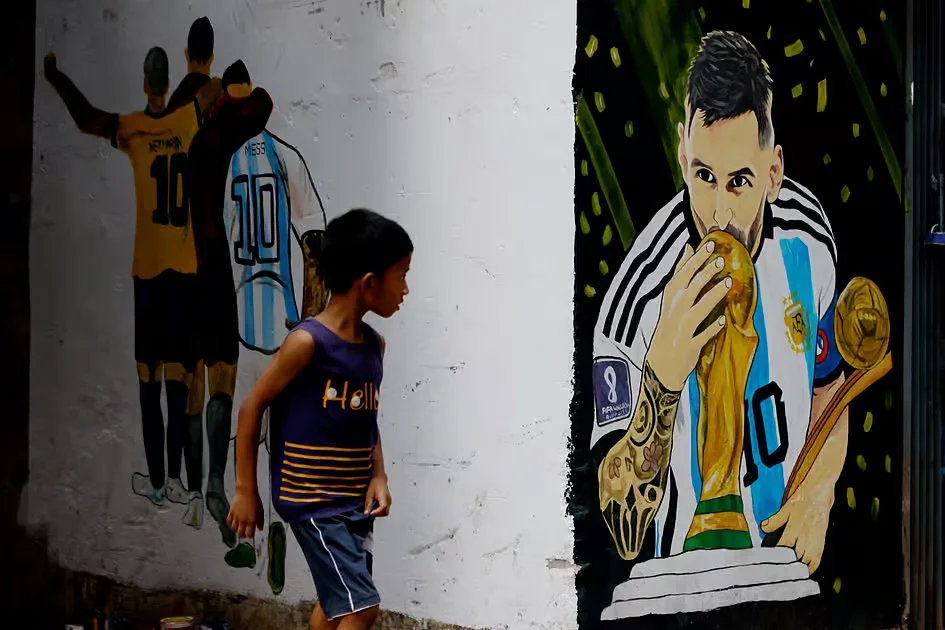
Back in 1998 Lionel Messi was only 11 when the World Cup craze reached fever pitch in Bangladesh. Farooq Hussain, a Dubai-based Bangladeshi expat, was only 15 but he still remembers his midnight adventure.
Play and predict your Fifa World Cup 2026 champion here
Hussain would quietly leave his house with his brother in the middle of the night to watch his favourite team, Argentina, play in the 1998 World Cup.
“My brother and cousins were all Argentina supporters. I grew up hearing stories about Diego Maradona from them and became so fascinated that I wanted to watch Argentina too,” Hussain recalled.
But they had one problem: none of the households in his village, Ghagra, owned a television.
“About 40 per cent of the people in our village are Muslims, and nobody had a television set back then,” he said.
“So we would tiptoe out of the house while our parents were asleep and head to a friend’s home in the Hindu neighbourhood. All our Muslim friends would gather there to watch the World Cup matches late at night, and the conversation was always about either Brazil or Argentina.
For Hussain and his friends, the only divide was football allegiance. “Nothing else mattered,” he said.
Hussain’s account challenges the narrative built by European influencers and ESPN football presenters in the US — that Messi’s popularity has turned Bangladesh into a ‘South Asian Argentina’.
Several Western media houses ran a viral video of wild celebrations in Bangladesh after Messi’s hat trick in the World Cup game against Algeria.
“It’s not true at all. I have been a die-hard fan of Argentina even before Messi started playing football,” said Hussain.
“I didn’t get to watch Maradona. He had already retired when I started watching World Cups. My big hero in the late 1990s was Gabriel Batistuta. He was an absolute superstar in Bangladesh.”
Another football-loving Bangladeshi expat, Saifur Rahman, also credited Maradona for Argentina’s cult status as a football team in Bangladesh.
“Our love for Argentina started with Maradona in the 1980s – when television had started to enter the middle-class households,” the Dubai-based media and PR professional said.
“Bangladesh Television had started broadcasting in ‘colour’ from ‘black and white’ in 1981. Bangladesh TV had also started broadcasting matches from the 1982 World Cup when the name Diego Maradona first caught our attention.
“The World Cup 1986 in Mexico had cemented Argentina’s position into the football fans’ mindset – when Maradona lifted the World Cup.
“Over the last four decades, this love affair with Argentina continued to grow, influenced by Maradona and later on by Lionel Messi. It has now become a craze.”
Even the entertainment industry is cashing in on the country’s obsession with Argentina and Brazil football teams.
“In Bangladesh, there are TV dramas and comedies built around Brazil and Argentina fandom — where young boys and girls accept or reject marriage proposals based on which team they support,” said Rahman.
Pele and Che Guevara
Until Argentina emerged as a World Cup powerhouse, only one team ruled the roost in Bangladesh — Brazil.
But Barshon Kabir, Sports Editor at NTV, says football was not the only reason Bangladesh felt a connection with Brazil.
“Before Argentina won their first World Cup in 1978, Brazil dominated the imagination of football fans here. They were already three-time world champions after their triumph in 1970,” he said.
“At that time, East Pakistan was going through the liberation movement for independence. Many people were inspired by revolutionary figures such as Che Guevara, who came from South America. Brazil, too, was from South America and it had the most famous football team in the world. Their biggest icon was Pelé, a Black man who came from a poor country that many Bangladeshis could relate to. So apart from their beautiful style of football, people here felt a natural connection with Brazil.
“And after Bangladesh gained independence in 1971, almost the entire country supported Brazil. During every World Cup, there was only one team to cheer for.”
But one man changed the football landscape in Bangladesh.
“Everything changed with the emergence of Diego Maradona. His extraordinary performances at the 1986 World Cup, where he almost single-handedly carried Argentina to the title, captivated fans,” he said.
“Maradona’s charisma drew an entire generation of Bangladeshis towards Argentina. That was when the country split into two camps — the yellow of Brazil and the blue and white of Argentina.
“Since then, every four years, you see the flags of these two countries flying from homes across Bangladesh. Some families proudly display Brazil’s colours, others Argentina’s.”
Messi’s impact
What the Western media failed to see is the solid platform laid by Maradona’s 1986 heroics for Argentina, making it easy for Messi to become the darling of Bangladesh.
“Messi did not have to build Argentina’s fan base here because it already existed, thanks to Maradona. What has amplified Messi’s popularity is that he emerged during the rise of social media,” Kabir said.
“Today, people constantly share videos and photos of Messi online. When those clips go viral, many in the West assume Bangladesh’s love for Argentina is a Messi phenomenon.
“Of course, Messi is hugely popular because he is Argentina’s greatest modern star. But older generations had been passionately supporting Argentina long before Messi became a household name.”
The Brazil fans
Mohammed Jasim, a Dubai resident, belongs to the yellow half of Bangladesh.
“I have been supporting Brazil since my childhood,” said Jasim, whose heroes are Ronaldo Nazario, Ronaldinho, Kaka, and Neymar Jr.
“The rise of Lionel Messi has increased Argentina’s popularity in Bangladesh. Messi’s incredible talent, consistency, and achievements have inspired millions of fans. His victory at the 2022 World Cup attracted even more supporters to Argentina.”
But Brazil’s fan base, Jasim says, remains very strong.
“Brazil have a glorious history, five World Cup titles, and generations of legendary players. So they enjoy huge support in Bangladesh,” he said.
“Even though Bangladesh does not play in the World Cup, people support their favourite teams with great passion. During major tournaments, streets are decorated with giant flags, houses are painted in team colours, and fans gather to watch matches together.
“And the debate between Brazil and Argentina supporters creates a festive atmosphere and makes football even more exciting.”
Until the 1990s, Bangladesh also had an exciting local football rivalry. Its two most famous teams, Mohammedan Sporting Club and Abahani Krira Chakra (now known as Abahani Limited Dhaka), regularly drew huge crowds in the Dhaka Derby.
But cricket’s growing popularity has now kept local football on the periphery.
Since their Asian Cup debut in 1980, the Bangladesh national team have failed to qualify for the continental showpiece.
But every four years, the nation comes alive with the magic of the World Cup.
“The atmosphere during a World Cup is extraordinary,” Kabir said.
“Giant screens are set up across Dhaka. Whenever Brazil or Argentina play, those public viewing areas are packed. You will see a bank employee sitting next to a rickshaw puller, both enjoying the match together.”
Bangladesh may not produce a world-class team of its own in the near future, but its love for the beautiful game is unlikely to fade.
“Football erases social boundaries in Bangladesh,” Kabir said.
“It is something truly unique and beautiful. You really have to experience a World Cup here to understand what it feels like.”
Source: Khaleej Times