

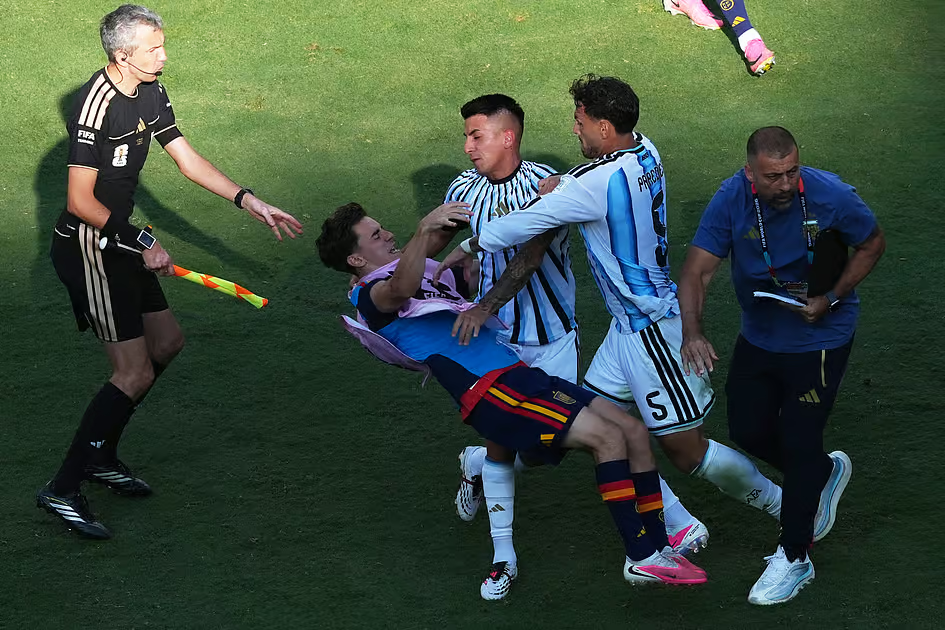
The rest of the world may have been seething in anger over Argentina’s cynical football, which ruined a spectacle as big as the World Cup final on Sunday, chances are that the majority of people in the South American country would look back on the team’s performance against Spain with pride.
Throwing any statistics — lack of a single shot on target until the end of 120 minutes of football, five yellow cards and a red — at them would be as futile as reasoning with Leandro Paredes about the pitfalls of grabbing an opponent by the throat and throwing him to the ground after being soundly beaten in a game of football.
Having arrived at the 2026 World Cup as defending champions but without the form that carried them to their greatest heights at Qatar 2022, Argentina turned to the ugly side of their football in North America in an attempt to make history.
What was at stake was the rare opportunity to emulate Brazil and Italy by becoming only the third team to defend the World Cup title.
Brazil were the last team to do it when the Garrincha-inspired side captivated fans with their dazzling football to claim the trophy in 1962.
But Argentina, struggling for top form and with a lot of their key players, including Julian Alvarez, Gonzalo Montiel and Cristian Romero, arriving for the tournament with injury issues, never came remotely close to playing their best football.
What they still had was an age-defying Lionel Messi, their incredible resilience and the street fighter’s spirit, walking a tightrope in every knockout match, which needed them to dig very deep until Spain exposed them brutally in the final.
Within the first 15 minutes, Lionel Scaloni’s team realised they had no chance of matching Spain’s midfield finesse.
Their response was to break the rhythm as tackles kept flying. While Spain had no clear chances for large periods despite their dominance, Argentina rarely managed to put four passes together, isolating Messi, who cut a frustrating figure.
As Spain kept pressing, Argentina kept blocking the spaces, making the game as dull and soulless as the half-time show from some of the biggest names from the entertainment industry at the New York New Jersey Stadium.
While the Rodri-inspired Spain remained committed to their brand of passing football, Argentina’s reluctance to even attempt a counter-attack killed the final as a spectacle.
The extremely negative tactics and the cynical fouls by Argentina reminded all football fans of the 1990 World Cup final between them and West Germany.
In what was a repeat of the 1986 final, West Germany overcame an ultra-defensive Argentina 1-0 with a late second-half goal.
The Argentinians, with a half-fit Diego Maradona in the side who played through the tournament with a swollen ankle, rode on their resilience and cynical game to reach the 1990 final before they were outclassed by the Germans.
But to this day, Argentinian fans are proud of their 1990 World Cup team — they even sing about them in their stadiums, praising the dogged determination that took them to the final.
While the neutrals still scoff at their anti-football tactics, for Argentinians, all that matters is their players showing the heart to defend deep when the stakes are high.
British football writer Jonathan Wilson, in his book, Angels With Dirty Faces: The Footballing History of Argentina, chronicles every tale — good, bad and ugly — of Argentinian football.
Wilson captures how a country that has produced three of the most sublimely gifted footballers of all time — Diego Maradona, Alfredo di Stefano and Messi — also thrives in the dark arts on football pitches, where the win-at-all-costs mentality is admired as much as the skills to dribble past defenders.
For Argentinian players, constantly arguing with referees and intimidating opponents are all part of their football culture since the time they had their first kickabout in the streets.
When they set their mind to football alone, Argentina can also play a mesmeric passing game, which can leave the romantics drooling.
But when the team is struggling, they can flip the switch to turn into street fighters, fighting tooth and nail for every ball the way many of these players battled for a chance to come out of poverty.
Against the classy Spaniards on Sunday, they became the new version of the 1990 World Cup team, adopting the same ugly tactics to try and drag the final to the penalty shootout.
Eventually, Ferran Torres held his nerve to ensure that the team that played football won the biggest trophy the sport can offer.
Source: Khaleej Times