

During a recent podcast on the YouTube channel Lucas TYLTY, Gabriel Batistuta, who once enthralled fans with his rockstar looks and a thunderous right foot that left goalkeepers with no time to react, paused for a moment when asked to name the person who inspired him to become a footballer.
The other guests on the panel were no ordinary people either — Ronaldo (the Brazilian one), Romario, Roberto Carlos, Roberto Baggio and Marco Materazzi.
Barring Ronaldo and Roberto Carlos, each one of them now carries patches of grey hair and pesky wrinkles, reminding us to make peace with one simple fact in life — no one beats time.
But not even one of them looked surprised when Batistuta named Diego Maradona as his biggest inspiration.
“When I was a kid, I didn’t play much football, but I had Maradona’s picture in my room,” Batistuta recalled.
“And I grew up like that, and then suddenly one day I was playing in a World Cup (1994) with him. I can’t put it into words because what I felt that day was tremendous.”
But every single one of them was surprised to see Batistuta’s voice crack, albeit momentarily, when the host asked him why Maradona still means so much more emotionally to Argentines than Lionel Messi.
“Leo is more of a good boy. He doesn’t get into trouble, he’s perfect,” Batistuta responded.
“But Diego was everything. He was trouble, he was an amazing player. He had problems, he made mistakes, like all of us. We’re not perfect, and we make mistakes. But when Diego made a mistake, everyone saw it. And so, people identified with him. That’s why I think Argentinians love him so much and identify with him so much because he was a part of all of us.”
Discovering the podcast a week after Argentina’s fall from grace following their World Cup final defeat to Spain felt strangely poetic.
A football superstar laying bare his very Argentinian soul was the moment you realized why it’s not the legend of Maradona alone, but the very identity of Argentine football that oscillates between magic and madness.
From hero to villain
Now, even two weeks after the lop-sided World Cup final at the New York-New Jersey Stadium ended in ugly scenes, the ramifications of the dark side of Argentine football have refused to fade. The global backlash over Argentina’s cynical game and some of their players’ embarrassing behaviour has been unprecedented.
An online petition on Change.org seeking a life ban from the World Cup for the South American team has recently crossed more than 23 million signatures, with people from more than 170 countries voting for the three-time champions’ permanent ouster from the global showpiece.
According to a Goal.com report, the online campaign is on the brink of entering the Guinness World Records as the ‘most signed petition in history’.
From conspiracy theories over alleged Fifa favouritism in some refereeing decisions to the negative football in the final and the political act of displaying a banner over the Falkland Islands (known as Malvinas in Argentina), it’s incredible to see how ‘La Albiceleste’ has gone from every neutral’s favourite in Qatar 2022 to global villains in 2026.
Amid the fallout from a cynical campaign, it boggles the mind when you think of the morning of December 18, 2022. Barely a few hours before the World Cup final between Argentina and France — hordes of fans arrived in Qatar from Mexico, China, India and many other countries without match tickets, hoping against hope to get lucky and cheer for Messi.
We still don’t know how many of them managed to get a seat at Lusail Stadium that night, but their hero, Messi, in Peter Drury’s immortal words, shook ‘hands with paradise’ after the South Americans overcame a stirring French fightback to complete a fairytale triumph.
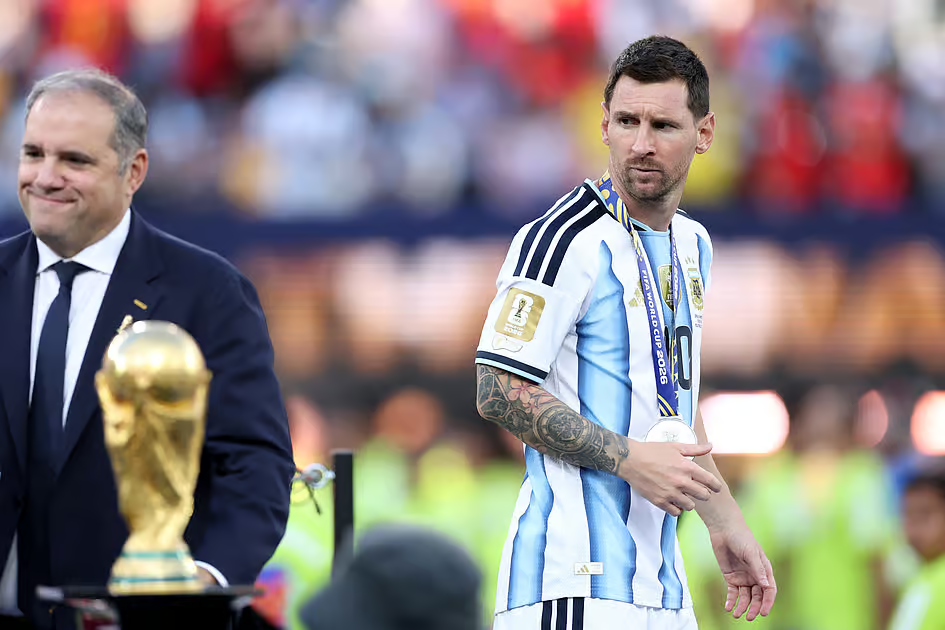
Now even Messi is bearing the brunt of the backlash for remaining a silent spectator when some of his teammates lost their heads after losing the final, assaulting a few Spanish players in scenes uglier than the football they had produced against Spain.
This was the same team that embodied the romantic side of the country’s football in the Qatar 2022 knockout rounds, their technical and fluid passing game leaving the aesthetes drooling.
Four years later, Lionel Scaloni’s men were a pale shadow of their triumphant 2022 team, pinning their hopes on a 39-year-old Messi to perform miracles in every brutal game and resorting to dark arts. It reminded many observers of the 1960s, when the national team and Estudiantes, one of the country’s most prominent clubs, which won three back-to-back Copa Libertadores (South America’s Champions League) titles from 1968 to 1970, earned notoriety for their violent tackles and win-at-all-cost mentality.
Between art and anarchy
The mystique of Maradona, who unleashed both the beast and the beauty within him with his ‘Hand of God’ and ‘Goal of the Century’ at Azteca, inflicting misery on England just four years after the Falklands War with Argentina, has compelled many English sports writers to delve deeper into the paradox of Argentine football.
Among them is Jonathan Wilson, a veteran football writer whose book, ‘Angels with Dirty Faces: The Footballing History of Argentina’, narrates how Argentina’s 28-year period of glorious passing football came to a stuttering halt at the 1958 World Cup when they slumped to a 6-1 defeat against Czechoslovakia.
In Wilson’s words, the humiliating defeat led to an era of ‘anti-football’. While the team was disorganized in 1962, their aggressive tackles in the 1966 quarter-final led to England manager Alf Ramsey stopping his players from swapping shirts with Argentinians after the final whistle.
It wasn’t until 1978 that Argentina, under the chain-smoking manager Cesar Luis Menotti, returned to its free-flowing style of football, which culminated in them winning their first World Cup on home soil.
But the streak of aggression and gamesmanship remained an integral part of their football — whether it was at their 1986 triumph in Mexico under Carlos Bilardo or their dogged determination to win ugly in their runners-up finish in 1990, Argentina continued to leave neutrals perplexed with their contrasting styles.
During an interview on Off The Ball, a YouTube channel, Wilson, who spent a few years in Buenos Aires to work on his book, revealed the contrast between the Argentinian players who primarily built their game on the streets and English footballers, who are shaped in elite football academies.
“The classic Argentinian player is the player from the streets. And the two things you learn playing on the streets — technical skill, because you’re playing on uneven surfaces, there’ll be a lot of people in a very small area. But you also learn how to look after yourself and how to win without the constraints of the laws. In the English schools, there’d be a teacher ready to blow the whistle if things got out of hand,” Wilson said.
“Whereas playing on the streets, you don’t have that, you’ve got to be able to handle yourself. And that means sticking the elbow in when you need to, it means unsettling your opponent psychologically, it means doing all the cheating you can as long as you get away with it.”
When Argentina brings the spirit of street football to the international game, especially when they face a better team, it ruffles feathers in global media, especially in England.
But the Argentinians, Wilson says, have always been comfortable in their own skin.
“I think it’s just ingrained. I mean, there’s absolutely no sense of shame,” he said. “They would regard it as being a very sort of Western or European hang-up. The idea of fair play, they don’t quite get it. They know it’s something that we do, but for them, what’s the point? That’s not how the world is.”
Beyond Argentina’s borders
As a British football writer who is based in Brazil, covering South American World Cup qualifying matches and Copa Libertadores games for close to three decades, Tim Vickery recently argued that the ruthless physical side of football is not limited to Argentina alone.
Most World Cup qualifiers in South America are littered with ugly fouls and provocations. Egged on by hostile crowds, home teams’ sharp elbows even compel the heavyweights — Brazil and Argentina — to prepare for a scrap, sometimes in the stifling afternoon heat of Barranquilla, a Colombian city that nestles near the Caribbean Sea, and sometimes in the high altitudes of La Paz, Bolivia, and Quito, Ecuador.
The atmosphere is no less intimidating in Paraguay, Peru, Chile and Uruguay, where a group of fans even turned up at the airport in 2001 to intimidate the Australian team, with one of them even spitting at an Aussie player ahead of the 2002 World Cup play-off.
“The national football team is the biggest symbol of a nation (in South America), so losing a game feels like being invaded by barbarians who must be repelled by any means — foul or fair,” Vickery said on the YouTube channel Brazilian Shirt Name Podcast.
It’s not difficult to see why the veteran football journalist admired Paraguay’s defiance against France in the round of 16 last month — even as the European media, especially the pundits in England, Vickery’s homeland, scoffed at the Paraguayans’ overly negative tactics in the 1-0 defeat.
“Paraguay were able to frustrate the French for long periods of the game with a mixture of mainly good old-fashioned defending and some of the dark arts as well,” he said.
“I don’t want to go overboard on the dark arts, but it was a masterclass in them as well. I remember when VAR came in, there was this kind of anguish in some corners of South American football; they were like, ‘we’re not going to be able to get away with this’.”
But the South American dark arts, according to Vickery, have learned to coexist with VAR.
“What we’ve seen now is a Darwinian process of evolution. It’s adapting the dark arts to the VAR age,” he said.
“So you just do enough, like just a little elbow, low, not to the head, just a little niggle, and frustrate them and get under their skin. It’s not enough for VAR to call the referee, but it is enough to achieve its objective.”
The Messi evolution
In Batistuta’s words, Messi is the early-to-bed and early-to-rise kind of a ‘good boy’. But for more than a decade, the Barcelona talisman failed to win over the fans in Argentina.
To earn an equal share of space with Maradona in the Argentine consciousness, Messi also needed to go through the ‘Darwinian process of evolution’. He needed to become more of a leader and wear his Argentine heart on his sleeve, even if that meant cupping his ears to taunt the Netherlands bench after scoring a goal during that ill-tempered World Cup quarter-final clash in 2022.
The in-your-face celebration was a response to Dutch coach Louis van Gaal’s pre-match trash talk. While the rest of the world was shocked to see the Maradona-esque jibe at the rival bench, his compatriots revelled in seeing shades of a street fighter in the ‘little boy from Rosario’.
It’s a very Argentinian trait to get under the skin of the opponent on a football field.
Sitting half a world away in South Asia, many fans could be tempted to draw a parallel between the cultures of Argentinian football and the all-conquering Australian cricket teams of the 2000s.
The Australians blew rivals away with their all-round brilliance, but it was their sledging, aggressive appealing and confrontational attitude on the field that never made them popular champions, unlike the legendary West Indies teams of the 1970s and 1980s.
Renowned Indian sportswriter Sharda Ugra was in the press box covering several Australian matches.
“The Australian team was so good in cricket that they did not need to be disrespectful. They did not need to look down on others, and it is a very toxic masculinity kind of thing that was being played out,” she recalled.
“The whole thing of sledging and mental disintegration, I just felt it was a bit trifling to chat, and they didn’t need to do it.
“And the contrast with the Argentinians and their football is that what you see is their desperation when they play because they’ve always been that kind of a team. They’ve always had that street fighter kind of an image.”
Nikhil Naz, a senior Indian television journalist who covered the 2022 Qatar World Cup, shared an interesting story of being at the receiving end of rough Argentinian tactics.
“I was playing a corporate football tournament in England. There was a team from Argentina, and teams from Ireland, Sweden, Vietnam and India. Even in a corporate event, the Argentinian team played in that style,” he said.
“They didn’t mind putting in an extra tackle, troubling the other player, poking him, trying to get inside his head. Being around Argentinian fans and players (at Qatar 2022), I’ve realised it’s just part of their culture. That’s how they play their sport. But they’re very different people outside the field.”
Playing for the people
Lautaro Martinez, the Inter Milan striker, was on the field for barely 10 minutes in the semifinal against England. A centre-forward of modest height at five feet nine, he snarled and pushed the towering England defenders for space before heading home the winner in the dying minutes from a sublime Messi cross and screaming into the camera to spark wild celebrations.
Barely half an hour after the final whistle, the same player was unable to raise his head as his voice cracked during an interview in which he remembered his family’s sacrifices, recalling how he had dreamed of scoring a goal like that in a big World Cup match ever since his father gave him his first pair of boots.
Every four years, the Argentinian team brings thousands of supporters to the World Cup. Many of them take loans or sell cars and other properties to be able to travel and cheer for them from the stands.
I bumped into one such fan — Federico — about an hour after Argentina overcame the Netherlands on penalties in the 2022 World Cup quarter-finals.
The young Argentine wiped away tears after I approached him for an interview.
“I spent everything to be here to support this team. I am so, so happy now,” said Federico, who was working as a delivery boy in Germany.
“For the past one year, I have been living and working in Germany, just to come to Qatar for this World Cup. I haven’t seen my family for one year.
“Football means everything to us. Argentina have a lot of problems — economic problems, social problems. Football is the only moment when Argentina is united!”
The connection between the players and their fans, who never stop singing, is unlike anything I have experienced during the whole month of the Qatar World Cup.
The rest of the world may continue to vilify them for some of their antics in the 2026 World Cup final, but Argentina are unlikely to change how they play their football.
For them, it’s about doing whatever it takes to win for their people. And this was a team which almost won everything in the past five years — Copa America in 2021 and 2024, the World Cup in 2022 and a World Cup runners-up medal in 2026.
Vickery smiled when a panelist on ESPN asked him if the global backlash over the final performance could change Argentina’s approach to football.
“They went home to a hero’s welcome. And you have to remember that Argentina went from 1993 until 2021 without winning a senior title. And then with the Scaloni project, extraordinarily, during those five years (from 2021 to 2026), they won almost everything. So the abiding sense was one of gratitude to this team,” Vickery said.
“Of course, they don’t take losing very well. They’re not the greatest losers in the world. But I can tell you in Argentina and in much of South America, it’s an absolute non-issue. It seems to offend maybe the Anglo sensibilities. But certainly the way that Paraguay or Argentina conducted themselves in the World Cup would be seen as using the weapons that you’ve got in order to go to war.”
Scaloni’s men may have become villains in the eyes of the world, but veteran Argentinian sports journalist Alejandro Magdaleno says this team is now part of the country’s footballing folklore.
“This group has written its name in golden letters for succeeding with a high-level, technically brilliant style of football in Qatar, and for defending the flag — not just the shirt — with honour and patriotism in the US,” Magdaleno said.
“That is why this Argentina team represents ordinary Argentine people — it plays like ordinary people, and it makes the extraordinary seem ordinary.
“The emotion this team conveyed has no comparison. They are runners-up who will remain etched in memory; the team that made an entire country take to the streets to celebrate even without becoming champions. And that is because of the way they played, and the pride they showed in representing an entire nation.”
Magdaleno’s words reminded you of Batistuta’s ode to Maradona, the flawed genius who received unconditional love from his countrymen, reflecting the unique relationship between football and people in Argentina, where the line between beauty and the beast is often blurred.
Source: Khaleej Times