

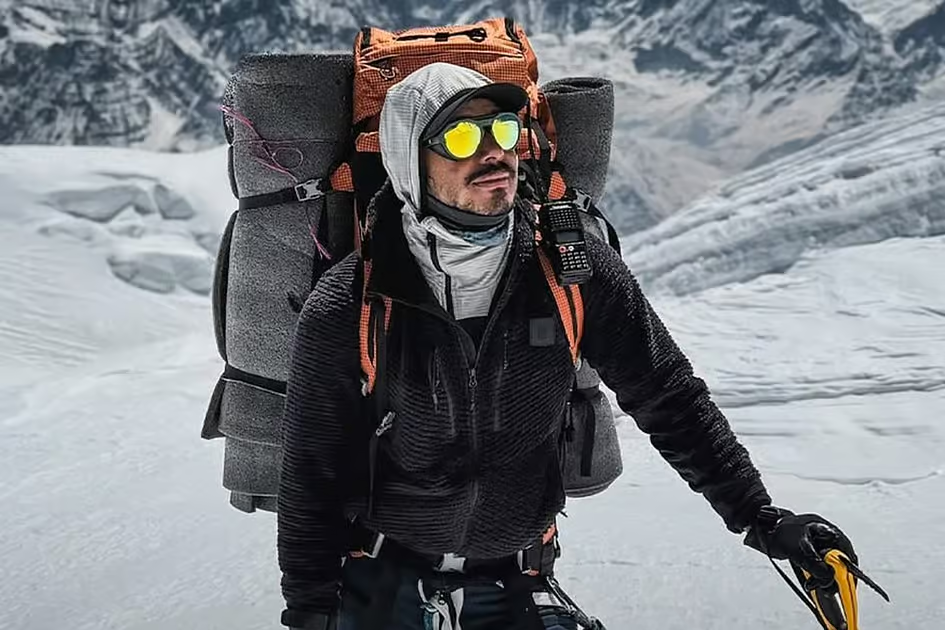
The death of British-Nepali mountaineer Nirmal Purja on Broad Peak in Pakistan’s Karakoram range recently left the climbing world shocked. However, what has emerged since is not just a period of mourning, but also a wider debate about rescue timelines and the ground realities of emergency response at extreme altitudes. The incident, which also claimed the lives of other climbers and support staff, has drawn global attention because of the questions raised over how quickly rescue efforts were able to begin.
As the discussion spread online, some climbers took to social media to ask if the emergency alarm could’ve been raised sooner. Addressing these concerns, Pakistani high-altitude mountaineer Naila Kiani, a member of the Alpine Club of Pakistan, has pointed out that Pakistan’s high-altitude rescue system operates under severe logistical constraints, with limited communication from the mountain, dependence on military helicopters instead of commercial rescue services and harsh weather conditions that often prevent operation until daylight and approvals are in place.
Stay up to date with the latest news. Follow KT on WhatsApp Channels.
First Pakistani woman to climb 12 of the 14 eight-thousanders, Kiani laid emphasis on operational realities of mountaineering in the Karakoram, which is one of the world’s most remote mountain regions.
“Several factors affected both the timing and logistics of the rescue,” Kiani told Khaleej Times. “Initial information indicates there was roughly a 10-hour delay before the expedition’s base camp team notified the authorities. The reasons for that delay are still under investigation and it would be inappropriate to speculate before the findings are complete.”
Detailing the sequence of events after the alarm was raised, she explained that both ground and aerial efforts faced operational barriers. “Once the authorities were informed, the rescue process began immediately. However, the notification came between 9pm and 10pm, and any ground or helicopter operations cannot take place at night. In Pakistan, high-altitude rescues rely on military helicopters rather than private rescue services and flights are subject to weather, daylight and military approval procedures. Helicopter approvals were obtained overnight, with aircraft departing in the morning,” said Kiani, adding that lack of a dedicated commercial infrastructure further complicated the situation on ground.
“Further to that, ground rescue was equally challenging due to dangerous mountain conditions, limited personnel remaining in the Karakoram late in the season and the extreme terrain. A couple of Pakistani climbers were sent by helicopter first thing in the morning,” she said. “Also, in this incident, climbers reportedly fell between roughly 700 and 1,600 metres. Avalanches of this magnitude are frequently unsurvivable due to the forces involved. Even recovering the bodies required rescuers to expose themselves to considerable danger.”
Kiani further added, “The expedition team or the climbers’ home team are responsible for alerting the authorities when an emergency occurs. The authorities depend on those reports because communication from the mountain is often limited. In this case, the initial delay appears to have occurred before the authorities were informed. Usually, one of the surviving members of the accident also informs the base camp, but this avalanche took everyone down. Once the notification was received, the authorities initiated approvals for helicopter deployment immediately.”
Drawing comparisons with setups in other popular climbing regions, she also noted significant structural differences that impact response capabilities. “Unlike Nepal, Pakistan does not have private commercial helicopter rescue companies dedicated to mountaineering. High-altitude rescues depend on military helicopters based in Skardu, making the process more complex and weather dependent. Communication between teams on the mountain, base camp and authorities is also limited and it can take several days for people to travel from Karakoram base camps to Skardu after an expedition. For that reason, a formal review of what happened typically begins only after rescue or recovery efforts are completed because the immediate priority is saving lives and recovering climbers where possible.”
Kiani added that the incident has affected international climbing community, “not only Pakistanis, but Nepali Sherpas, as well as climbers from China, the United States and Oman”. “Many inaccurate reports and graphic material circulated online while families were still waiting for confirmed information, which can cause additional distress. People use such tragedies for likes and views on social media and at this stage much of the discussion is still speculation, and speculation often causes more pain than it resolves.”
Emphasising on the importance of allowing the ongoing investigation to run its course, she added, “People absolutely have the right to ask difficult questions about whether procedures were followed correctly, whether unnecessary risks were taken and whether any party should be held accountable. The only request is that conclusions should not be reached before the facts are established. Once those investigations conclude, a thorough and transparent process should determine what happened and if mistakes were made, those responsible should be held accountable.”
Pakistan Alpine Club, of which Kiani is a member, has been working closely with the ground rescue teams, local authorities, the military, Nepali counterparts, expedition representatives and some of the affected families. Kiani acknowledges the broader need for structural evolution within the region’s climbing sector.
“This tragedy also highlights the broader context of mountaineering in Pakistan. The country currently relies on military helicopters for high-altitude rescues and there is a strong need for dedicated commercial rescue helicopter services,” she added. “However, mountaineering remains a relatively small industry in Pakistan, making it difficult to attract private investment in that capability.”
She said that the sector is also working to raise standards in areas, such as guide training and internationally recognised certifications. “None of these challenges are new and the Pakistan Alpine Club has been actively working over the past year to strengthen the country’s mountaineering ecosystem. Progress is being made but building world-class infrastructure and rescue capacity will take time.”
Source: Khaleej Times