

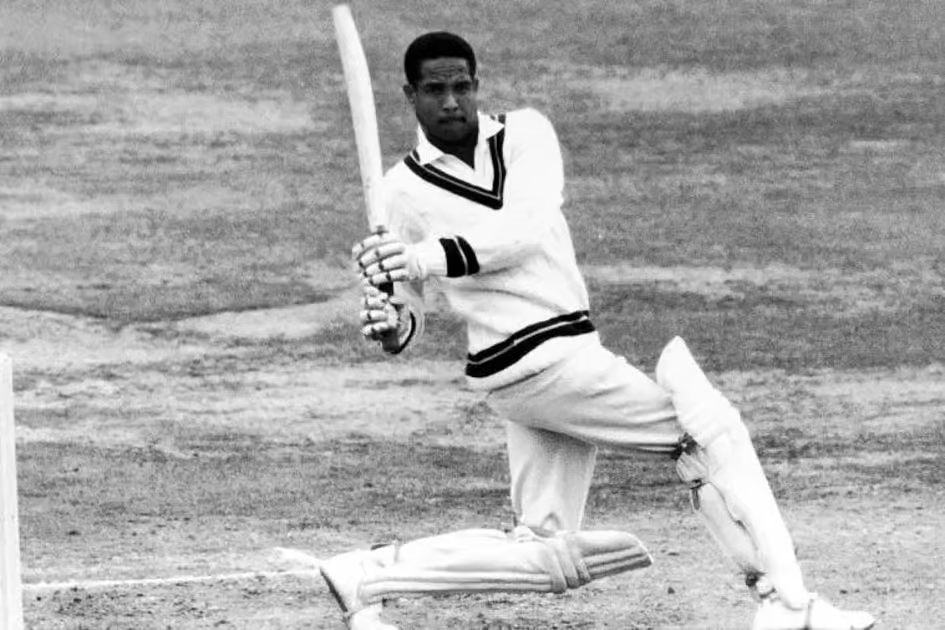
It’s been more than 54 years since that incredible day of cricket in Melbourne. But for former Indian cricketer Farokh Engineer, 88, it still feels like yesterday.
For roughly 30 minutes, Engineer had a ringside view of one of the greatest performances ever delivered by anyone on a cricket pitch, albeit in an unofficial match.
It was the 1972 series between Australia and the World XI, a team featuring elite cricketers from the rest of the Test-playing countries.
The event would never have taken place if South Africa’s Australia tour for a bilateral series had not been cancelled because of the anti-apartheid protests in the African country.
The cancellation of the bilateral series compelled the Australian cricket board to look for alternatives — the result of which was a series of matches between Australia and the who’s who of cricket, who played for the World XI.
None was bigger than Sir Garfield Sobers, the legendary West Indies all-rounder who passed away at the age of 89 last week.
Sobers captained the World XI, which had top players like Zaheer Abbas, Sunil Gavaskar, Engineer, Bishan Singh Bedi, Clive Lloyd, and the Pollock brothers from South Africa, Graeme and Peter.
The Ian Chappell-led Australian team had a rookie fast bowler, Dennis Lillee. A tearaway quick who would go on to become one of the greatest fast bowlers of all time, Lillee had just started his international career when he led the Australian bowling attack against the star-studded World XI.
Sobers, on the other hand, was a 36-year-old veteran who had already played Test cricket for 18 years, building his legacy as the only player in the history of the game who could bowl both fast and different types of left-arm spin, apart from his genius with the bat.
While the Australian pace spearhead was a rising sensation, Sobers was the greatest icon whose freakish all-round talent had already left as big an impact on the sport as Don Bradman’s otherworldly Test batting average of 99.94.
But Sobers had made no impact at all in the series when the third Test match began in Melbourne after the second Test was won easily by Australia, with the teams sharing the spoils in the first game.
With the series on the line, Sobers was dismissed for a duck by a Lillee bouncer in the modest World XI first-innings score of 184 all out.
The West Indian may have been in the twilight of his career, but being bounced out by an emerging fast bowler hurt his ego.
When the Australians came out to bat, Sobers wanted to show Lillee that he also knew how to bowl fast and short.
Engineer, who was keeping wickets for the World XI, still remembers what Sobers told him when Lillee, a tailender, came out to bat.
“Garry told me, ‘Just go back a few steps. I’m going to show this fellow what fast bowling is all about.’ And the second new ball had just been taken, and my Lord, he bowled four or five bouncers in a row,” Engineer recalled during an interview with Khaleej Times.
“He almost decapitated Dennis Lillee. And he (Lillee) kept looking at me behind the stumps, saying, ‘What the hell is happening?’ And I said, ‘How does it feel for you to be at the receiving end?’ And then, of course, Garry bowled him.”
Lillee was seething with anger as he walked back to the pavilion.
“When he went to the Australian dressing room, he threw his bat and came to our dressing room and pointed a finger at Garry: ‘Hey you, I’ll see you out there when you come out to bat.’ Garry told him, ‘Well, you’ve got a ball in your hands. I’ve got a bat in my hands. Let’s see.’”
That was the spark that launched the greatest innings ever played on Australian soil.
In an incredible career, Sobers had scored a triple century and dominated bowling attacks across the world, scoring over 8,000 Test runs at a magnificent average of 57.78, with 26 hundreds.
As the only bowler in the entire history of cricket who bowled fast and switched to spin depending on the conditions of the wicket, Sobers took 235 wickets at a highly impressive average of 34.03, with six five-wicket hauls from 93 matches.
But on that day, what the left-handed magician produced with the bat at the Melbourne Cricket Ground still leaves cricket romantics purring.
He scored a stunning 254, driving, pulling and hooking Lillee to all parts of the ground to set up a resounding 96-run win for the World XI.
“Garry used to bat at number seven also, but that day he decided to go in earlier in the innings. I think he came in two down. So he went in and destroyed Lillee,” Engineer said.
“I was at the other end for about half an hour as his batting partner, encouraging him between overs while he and Dennis kept exchanging words. It was wonderful cricket and wonderful theatre.”
Such was the quality of Sobers’ shot-making that it even brought the incomparable Bradman, who had retired in 1948, to his feet.
“Bradman said it was the finest innings he’d ever seen (in Australia), and certainly it was the finest innings I have ever seen anywhere,” Engineer said.
“I have never seen anyone hit a fast bowler like Lillee the way Garry did in that innings. He treated him like a schoolboy cricketer. That 254 was an amazing innings.”
A big competitor on the field, Sobers also had a big heart, and Engineer got to discover the other side of the great cricketer when he played against him in 1967 during the India-West Indies Test match in Chennai.
Facing Sobers and Wes Hall and Charlie Griffith, the fearsome fast bowling duo, for the first time, Engineer, a swashbuckling batter, threw caution to the wind as he scored a magnificent hundred.
The former wicketkeeper-batter said reaching the hundred was as sweet as getting a pat on the back from Sobers.
“When I scored my fastest Test hundred against the West Indies, Garry was the very first person to come over. He hugged me, shook my hand and said, ‘Although it was against us, that was one of the best innings I’ve seen anyone play against Wes Hall, Charlie Griffith and myself,’” he said.
“Coming from Garry Sobers, that was probably the biggest compliment I’ve ever received. He sincerely meant those words. We were not friends at that time; we were just opponents. That’s what made his words so special.”
Cricket, Engineer says, will never see another genius like Sobers, who had the unique combination of spin and fast bowling, batting, and superb fielding skills.
“He could do anything on a cricket field. Like Lionel Messi in football. But they were different people. Sobers was a typical Caribbean, happy-go-lucky guy. I think Messi is more meticulous and more of an example for youngsters to follow,” Engineer said.
“Garry was different. He would go out for a late-night party, and then the next morning, he would score a sublime Test hundred.
“In that sense, he was like George Best. George and I were neighbours in Manchester. I knew he would party all night, but the next day he’d dribble past the best defenders and score unbelievable goals for Manchester United.
“Geniuses like Garry Sobers and George Best could get away with those things. I certainly wouldn’t recommend young players to try to copy them. They were one-offs.”
But in terms of cricket alone, was he really the greatest of all time, as many pundits suggest?
“Of course. He was the most complete cricketer I have ever seen. There will never be anyone like him,” Engineer said.
“People often talk about great batsmen or great bowlers, but Garry mastered everything. He could bowl fast, bowl spin, bowl Chinaman, field brilliantly, and then go out and play some of the greatest innings you’ve ever seen.
“To excel simultaneously as a fast bowler, a spinner, a fantastic batsman and a fantastic fielder—that combination of four was extraordinary. That’s why Garry Sobers was unique.”
Source: Khaleej Times