

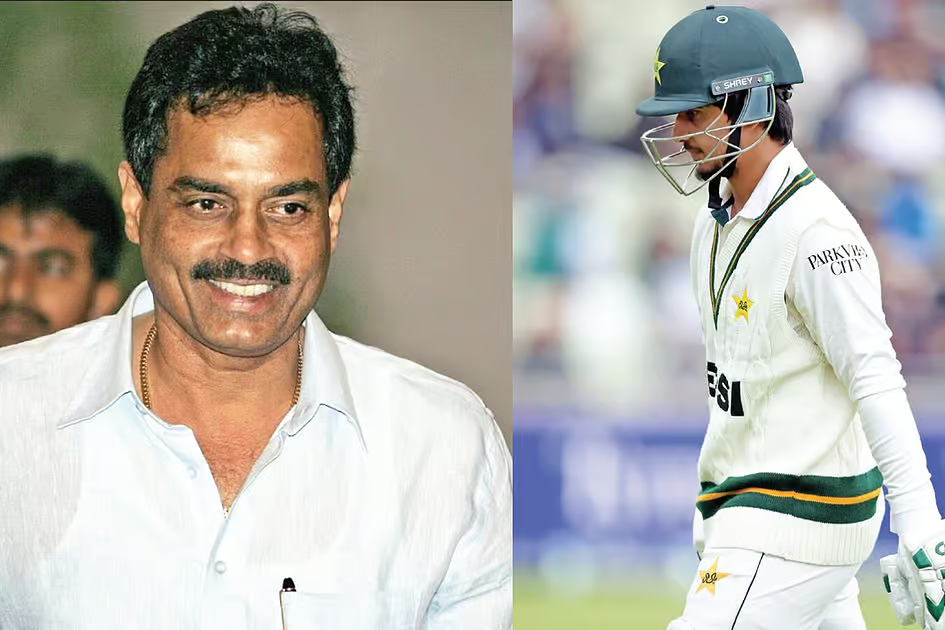
Unlike many great cricketers of the past who embraced the glamorous life of broadcasting after retirement, sharing their expertise on television and travelling the world to commentate on high-profile matches at iconic venues, Dilip Vengsarkar was happy to work quietly in the background after retiring from the game as one of India’s greatest Test batsmen of all time.
Vengsarkar built cricket academies in Mumbai and Pune and even paid for the education of young cricketers who came from underprivileged backgrounds.
In 2002, when the Indian cricket board launched the Talent Resource Development Wing to develop the game at the grassroots level in far-flung corners of the country, Vengsarkar was appointed as its chairman.
The former India captain travelled to several small towns across the country to identify young talent and groom them in domestic cricket.
The results were astonishing as India discovered MS Dhoni, Suresh Raina, RP Singh and Sreesanth, with all of them emerging from places that had little or no history of producing international cricketers.
In a 2022 interview with Khaleej Times, Vengsarkar said his role in developing cricketers at grassroots level after his retirement gives him more satisfaction than the three Test hundreds he famously scored at Lord’s — he remains the only foreign batsman to have achieved this feat at the hallowed ground.
But now this 70-year-old Indian cricket legend feels incredibly sad to see how a poor domestic system has triggered a cricket decline in Pakistan.
Having played against Zaheer Abbas, Javed Miandad, Imran Khan, Abdul Qadir and Wasim Akram, Vengsarkar admits Pakistan was an incredibly difficult team to play against in the 1980s.
The new West Indies?
Pakistan’s decline, especially in Test matches, is alarming for cricket as the sport, according to Vengsarkar, cannot afford to see another giant repeating the mistakes of the West Indies.
Once the most dominant team, the West Indies now produce mostly white-ball stars, with their red-ball team hitting a nadir.
Pakistan, Vengsarkar believes, is beginning to make the same mistakes, which became more evident during the catastrophic Test series defeat recently in England when seven players were sent home in the middle of the series as punishment for poor performances.
But such knee-jerk reactions can never solve problems if the domestic structure is poor, according to Vengsarkar.
“I would blame this on the lack of experience among administrators or selectors. That is a typical knee-jerk reaction from selectors and administrators who do not have enough cricketing experience,” Vengsarkar told the Khaleej Times.
“Here, I would like to praise the BCCI because they do not allow their contracted players to play in leagues other than the IPL. They give a lot of importance to red-ball cricket, and that is one of the reasons India is doing well in Test cricket as well.”
But the former Indian captain admitted that most cricket boards lack the BCCI’s financial resources to stop players from going abroad for T20 leagues.
“Other boards allow their players to play T20 cricket all the time because there is a lot of money in these leagues,” he said.
“The boards may not have the funds to sustain those players, or they may simply play locally, so they have no option but to allow them to go and play all over the world. That is why they miss out on Test cricket and red-ball (domestic) cricket.”
Lack of stability
Vengsarkar said he could never make sense of the decision to send seven players home and replace them with players with very limited experience of playing in English conditions.
Saim Ayub was playing in the Caribbean Premier League when he was called up as one of the replacements for the third Test against England.
In a completely different format against the red-hot English pace attack in Birmingham, Ayub was brutally exposed, getting a pair of ducks.
“When you play in England, you need time to adapt to the conditions. You need at least a few matches to get used to them. If you send seven players home, that is almost the entire team. You cannot expect fresh players to come in and play Test cricket the next day, especially in England or Australia. It takes time,” he said.
Vengsarkar says stability in a cricket board is important for any country to sustain a good domestic cricket ecosystem, as great players can never be produced without a competitive four-day red-ball tournament.
“When Pakistan was at its peak, they had so many excellent players and match-winners. Many of them also used to play county cricket in England. Even if they were not playing regularly in their own country, they might have played a few games there, but they were spending almost five months of the year playing in England,” he said.
“So they gained valuable experience and exposure to English cricket. That helped them when they came back to play for Pakistan or toured other countries.”
Even Pakistan’s fast bowling icons, Imran Khan, Wasim Akram and Waqar Younis, were shaped in domestic cricket.
“If you look at almost all the great fast bowlers Pakistan produced in the 1970s and 1980s, they played county cricket. That experience certainly helped them develop as bowlers,” he said.
“County cricket, especially, helps fast bowlers tremendously. They get experience and exposure to different conditions and learn how to bowl the right line and length according to the conditions, the wickets and the situation. You learn quickly there.”
Babar Azam, the finest batting talent to have emerged from Pakistan in the past 10 years, is returning to domestic cricket after seven years amid a big struggle for Test runs, having not scored a hundred in the format since 2022.
Babar’s return to peak form would be a delight to watch for everyone — no matter which side of the border you belong to.
Among those would be Vengsarkar, a man who fought some fierce cricketing battles on the field against Miandad. But as Wasim Akram revealed in an interview, ‘hours after fierce sledging in a match, they (Vengsarkar and Miandad) would be sitting together in a hotel room and sharing food.’
Therein lies food for thought. Perhaps, Pakistan can take inspiration from Vengsarkar’s success in identifying and polishing talent at the grassroots level — far away from the glamour of the commentary box — as it looks to revive its cricket fortunes.
Source: Khaleej Times