

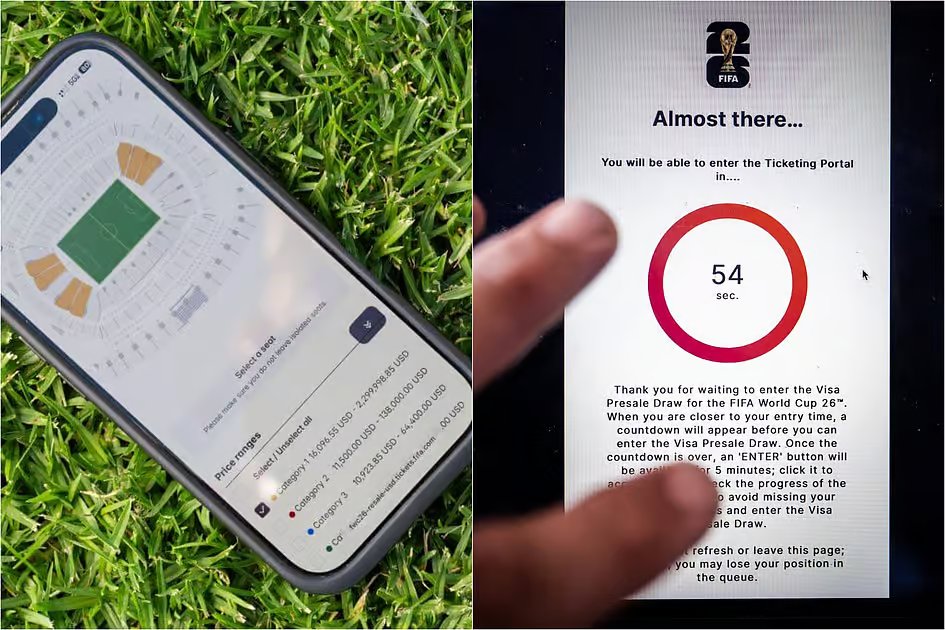
The runway to the 2026 World Cup has been littered with controversies, many stemming from the same source: tickets.
What began as a simple question — how do I get World Cup tickets? — became outrage over pricing, legal complaints, confusion, concerns about slow sales and much more.
Now, with first kick approaching, some fans have wondered: How did we get here? How and why did Fifa, global soccer’s nonprofit governing body, turn the World Cup into a forum for subpoenas and debates about capitalistic greed?
This is the nine-part answer.
Stay up to date with the latest news. Follow KT on WhatsApp Channels.
1. Opacity
Ever since this World Cup was awarded to North America back in 2018, fans have been interested in tickets. Their first point of frustration was that, up until September of 2025, Fifa did not release any information about how the ticketing process would work.
For previous men’s World Cups, Fifa had announced details further in advance. Almost two full years before Russia 2018, it held a news conference and revealed ticket prices, which were fixed and outlined on a tidy chart.
This time around, nearly every part of the process has been opaque. Fifa has almost always declined to say how many tickets would be available, for which matches, in which phases, at what prices. The many unknowns engendered anxiety among locals and foreigners alike, all of whom just wanted to know how they could attend a World Cup match.
2. The crypto ‘scam’
Fifa, many fans argue, then preyed on that anxiety by selling digital tokens called “Right To Buy”s via a crypto partner, Modex, and their digital collectibles platform, Fifa Collect.
Fifa sold tens of thousands of the tokens for hundreds of dollars apiece. Each one promised buyers the ability to purchase one or two World Cup tickets at a to-be-determined later date, for a to-be-determined full price; the “RTB”s did “not include the cost of the ticket(s) itself,” Fifa Collect clarified.
Once fans realised how much they’d have to pay for the actual tickets, after already spending hundreds on the RTBs, some told The Athletic they felt “ripped off,” “scammed” or “taken advantage of” by Fifa.
Fifa likely made tens of millions of dollars on the scheme, according to The Athletic’s reporting and analysis.
3. Glitches, errors, long waits and mistakes
When the sales process did finally begin on October 1, fans faced hours-long waits in digital queues. Some got error messages that cost them a shot at coveted tickets. Nearly every phase of the process has been complicated by technical glitches or a user-unfriendly ticketing portal that has made the purchasing process stressful and difficult to comprehend.
Some of the waits and laborious steps were byproducts of Fifa’s efforts to block bots or restrict the gaming of its system by scalpers (though some found workarounds). The stress, to some extent, was inescapable given the volume of demand.
But other mistakes were unenforced. There have been erroneous emails and misdirected links; strict rate limits that booted innocent fans back to the end of queues; and seat assignments that separated families. All of it contributed to the craze.
4. The highest prices ever
Fifa’s initial prices, never announced but revealed by The Athletic in October, were by far the highest in World Cup history. Every ticket, for every match, in every category, was more expensive than any equivalent ticket in 2022, 2018, 2014 and so on.
Fifa, over the months that followed, consistently defended its prices on two grounds:
As a reflection of the North American market, where people regularly pay hundreds of dollars to attend sporting events.
As a source of revenue that would ultimately be re-invested in the development of soccer globally.
Fans, however, blasted the pricing as “astonishing” and “unacceptable.” Football Supporters Europe called it a “monumental betrayal of the tradition of the World Cup.” Others used words like “extortionate” and “absolutely despicable.”
Fifa’s response? To raise the prices — again, and again, and again.
5. Dynamic pricing
For the first time ever, Fifa used what it called “variable pricing,” also known as dynamic pricing, an approach whereby prices fluctuate based on real or perceived demand.
Between October and April, Fifa hiked prices in at least one ticket category for 95 of the World Cup’s 104 matches; the average increase was 35 per cent.
By the end of the road, a Category 1 ticket to the final cost $10,990, up from $6,730 back in October. Group-stage prices ranged from $140 in Category 3 for less appealing games to $890 in Category 1 for Colombia vs Portugal and nearly $3,000 for the World Cup opener between Mexico and South Africa.
And they were no longer merely more expensive than tickets to previous World Cups. In every category, for every match, the April prices were more than twice as expensive as the equivalent tickets in 2022.
Estimate your World Cup costs
Ticket prices are Fifa’s prices as of April 2026. Initial lodging
estimates are based on hotel prices for a one-night stay in the selected city on the day of the game. All amounts are in USD.
6. Resale madness
Part of Fifa’s justification was that it could not control the relatively unregulated American resale market. If Fifa sold tickets at lower prices, the thinking went, scalpers would simply buy them and resell them at the same sky-high prices; so why shouldn’t Fifa try to make that money for itself?
Fifa, therefore, didn’t try to restrict the resale market; instead, it leaned in. For the first time, it launched its own resale platform with no price caps, and charged both the buyer and seller 15 percent on every sale.
Its unwillingness or inability to restrict resale allowed countless scalpers, or “brokers,” to infiltrate lotteries and get their hands on tickets as average fans struggled to get access.
7. American norms
At the heart of this entire saga is the tension inherent in Fifa’s selling of a global event in the American market. It’s a “very special” market, Fifa president Gianni Infantino argued, where “no one complains” about ticket prices “when you go to a concert or an NFL game.”
That, of course, is an exaggeration. Many Americans have in fact fumed about World Cup prices and others. But many have also conceded that “sporting events are expensive, man,” as former US soccer star Landon Donovan said last year.
As The Athletic detailed in December, Americans tend to view sport through a very different lens than the one through which most of Europe and the UK view it.
Fifa, rather than try to accommodate both, essentially adopted the American view. It sold “supporters tickets” — the ones reserved for diehard fans of the 48 participating countries — at the exact same prices as standard tickets. Backlash from fans worldwide led to a small carve-out of $60 tickets for around 1,000 supporters per match. But many were still left staring at prices far beyond any they’d ever seen — all while Fifa continued to defend its pricing as a reflection of “existing market practice for major entertainment and sporting events” in North America.
8. ‘Misleading’ maps
Throughout its first three sales phases, in October, November and the winter, Fifa said that it sold around three million tickets. The saga took an explosive turn when Fifa converted all those tickets to specific seats in April.
Previously, Fifa had sold the tickets by category, with each category corresponding to a range of sections at each stadium, per color-coded maps embedded in the ticketing portal and published online. The maps appeared to suggest that Category 1 tickets, the most expensive, could yield seats anywhere in a stadium’s lower bowl or, at some venues, in prime 200-level sections.
But when Fifa assigned ticket buyers to specific rows and sections, many found themselves stuck with the least desirable seats in Category 1 — or even in sections once designated as Category 2, because Fifa had changed the maps midstream.
They soon realised that many of the prime seats color-coded as Category 1 had actually been reserved for hospitality packages, which were being sold separately at higher rates; or held back so that Fifa could sell them at a higher “Front Category 1” price in April and May.
Both revelations led to an outcry. Fans and lawyers considered lawsuits. The attorney general of California wrote to Fifa, and a few weeks later, the attorneys general of New York and New Jersey announced they were investigating Fifa.
Fifa has not commented on the probe(s), nor on a variety of other issues beyond the statements and positions described above.
9. Sellouts?
Fifa’s other implicit defense of its prices was that, well, people were willing to pay them. The global governing body, which owns and runs the World Cup, said it received 508 million applications for tickets in its third lottery phase. A month later, Infantino said that “every match is already sold out.”
Fifa officials, though, quickly walked back that claim. Infantino later acknowledged that tickets were being held back. He said in April that his organization had “sold around 5 million” of the roughly 6.7 million expected to be available. “We could have” sold all tickets, Infantino claimed, but “we want to keep a few for continuous sale until the start of the tournament to give opportunities to latecomers.”
Ticketing experts, though, have explained that holding back tickets is a common strategy to create the illusion of scarcity and high demand, whether or not either exists.
For many World Cup games, it clearly does exist. But others, contrary to Infantino’s claims, still have thousands of tickets available with less than a week to go until the start of the tournament. Among them is the U.S. opener against Paraguay, which was initially priced as the third-most expensive match of the entire World Cup. Sales have lagged behind expectations — and, The Athletic reported in April, behind other matches at SoFi Stadium in Los Angeles, such as Iran-New Zealand three days later.
Most stadiums, it seems, will be mostly or completely full. But questions still swirl around others, including that U.S. opener. With less than two weeks to go, tickets began disappearing from Fifa’s portal, then appearing on resale sites for significantly lower prices. And yet, as of Sunday night, there were listings of around 10,000 tickets to that match on various resale sites — 5,311 on Fifa’s resale platform; around 3,000 on SeatGeek; roughly 2,000 on Ticketmaster; several hundred on StubHub; and more elsewhere.
Had the tickets been priced more reasonably all along, they would all be sold out; but Fifa’s prices turned a would-be certainty into the unending controversy of this World Cup.
This article originally appeared in The Athletic.
Source: Khaleej Times