

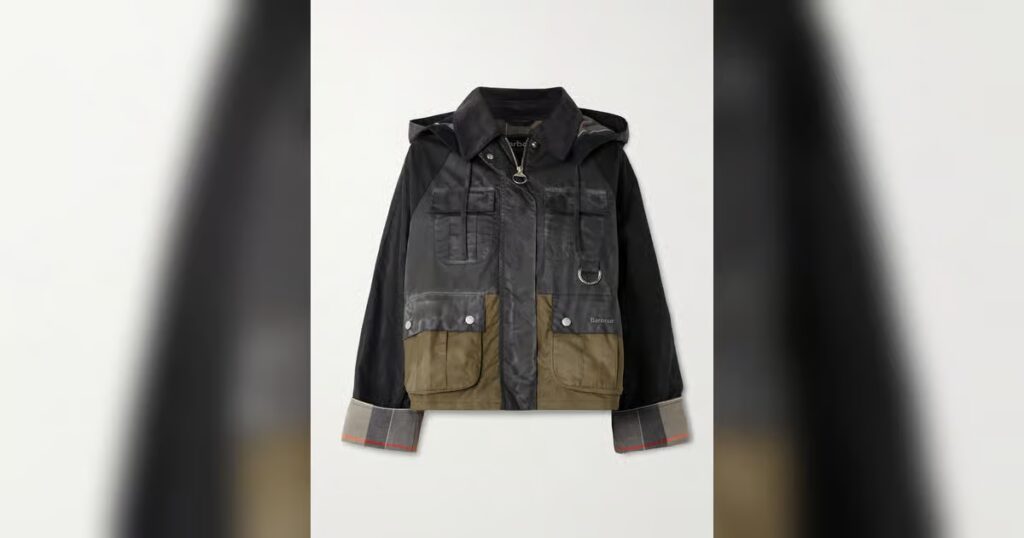
The fashion forecast and the actual forecast have, for once, aligned. This season’s defining look is British country heritage — waxed jackets, tartan linings, the whole Barbour-and-Labrador fantasy — and the UAE’s National Centre of Meteorology reckons a strong El Niño is about to hand us our wettest winter in years, the rains arriving early. For once, a Dubai fashion editor can recommend a waxed jacket with a straight face.
Barbour, that most improbable of Gulf retail propositions, opened its first Middle East stores here last year (Dubai Hills and Mirdif City Centre). For the uninitiated, it’s the 130-year-old British institution founded in 1894 to make oilskins for North Sea fishermen, before waxed cotton made it a countryside uniform — royal warrants and all. The ‘Liza’ I’ve earmarked (Dh1,720) is cut from its 1981 ‘Spey’ pattern, made for fly-fishing Scottish rivers.
It makes more sense than it should, because Dubai already speaks fluent country pursuit — it just does it in desert dialect. Swap the grouse moor for the falconry field, the Cotswold hunt for the endurance track, the point-to-point for Godolphin and the Dubai World Cup. The waxed jacket isn’t alien here; it’s the wet-weather cousin of the same aristocratic outdoorsiness we’ve always prized.
The city agrees, and not only sartorially. We’re busily building our own countryside — Emaar’s Grand Polo Club & Resort promises meadows, pastures and 180 stabled horses; Meraas sells Nad Al Sheba Gardens as a green ‘enclave’; Al Barari has traded on lush seclusion for years. This month the institutions land too: Harrow, Rugby and Queen Elizabeth’s schools open their doors, London’s grandest tables (Scott’s, two-Michelin star Gymkhana, Alan Yau’s Duck & Rice) colonise DIFC, and even Meghan has retreated to the Cotswolds.
Fashion agrees. Barbour has just made Sienna Miller the face of its autumn campaign, while its long-running Farm Rio tie-up splashes Brazilian tropical print across British oilskin — warm-climate exuberance meeting cold-climate function, precisely the negotiation Dubai makes every time it buys a wax jacket. At the upper-end, Bottega Veneta’s cult rubber-trimmed ‘Tire’ Chelsea boot is a stealth-luxe wellington for people who will never see a puddle. And the heritage bet pays: Burberry, gabardine-trench roots restored, posted its fourth straight quarter of growth in July, sales up five per cent.
This is British fashion reasserting itself at both ends of the market. Marks & Spencer marked a century of dressing the nation with its first-ever catwalk show at last week’s London Fashion Week. While, at the other extreme, Kering’s Alexander McQueen came home to show in the UK capital for the first time in 25 years, decamping from Paris in a back-to-its-roots bid to recover what made it great. High street to high fashion, the mood is defiantly British.
There’s a deeper current here than the weather, though. ‘Escape to the country’ has become a state of mind. As AI seeps into everything — nowhere more zealously than here, where it’s now a school subject and a government ministry — a countering hunger has set in for the analogue and the real: mud, grass, weather, a dog that isn’t an app. Heritage dressing is armour against the algorithm; nothing feels more defiantly human than a jacket re-waxed by hand and worn for 30 years.
It is also the precise antithesis of the Dubai bling playbook — no gold, no monogram, no discernible price. A battered wax jacket says nothing, and in a city built on the loud, that silence is the flex. Green, not gold.
So buy the Barbour. Wax it, don’t wash it, and wait for the rain the forecasters have promised. If it never comes, you’ll still look like you own a Labrador and a stretch of river — which, in this city, is close enough to inheriting the deeds.
Source: Khaleej Times