

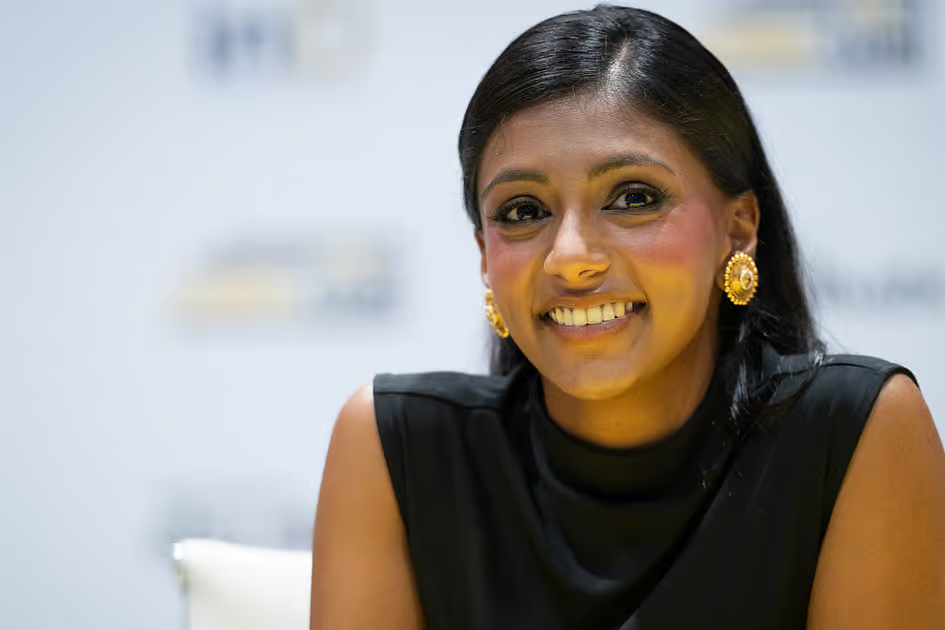
Charithra Chandran believes the entertainment industry has lost some of the momentum it gained around representation since the second season of Bridgerton was released in March 2022.
Speaking to Khaleej Times during the Middle East Film & Comic Con in Abu Dhabi, the British actress gave a candid response when asked whether the industry had genuinely changed since she appeared as Edwina Sharma in the Netflix period drama.
The 29-year-old British actress was born in Perth, Scotland, to Tamil Indian parents. She spent part of her early childhood in Tamil Nadu before returning to the UK, where she was raised. Chandran has previously described both India and the UK as home.
“Truthfully, no, I don’t,” she said. “I think that when Bridgerton season two was happening, there was a lot of change. And I think that across the world, we’ve maybe seen things go backwards a little bit.”
The actress said Bridgerton remains special to her for several reasons, including the sense of optimism surrounding the show and its South Asian representation.
“It just felt like a really hopeful time in so many different ways,” she said. “I know it’s not the answer everyone wants, but it’s the truthful answer.”
Chandran, who was visiting the UAE for the first time, said she had received a warm welcome in Abu Dhabi. The appearance also marked her first experience at a comic convention.
“I didn’t know anything about the UAE, really, and everyone has been so lovely,” she said. “It has been such a pleasant experience and a great way to meet people.”
Having appeared in two major Netflix productions, Bridgerton and the live-action adaptation of One Piece, Chandran has encountered fan communities in different parts of the world.
“I think that I know, but I can’t quite believe it,” she said when asked when she realised how large those communities were. “Knowing and believing are very different things.”
“You travel to such different parts of the world, and it is so humbling that no matter where I go, people connect with both these shows. I feel very lucky, and I feel like part of a community.”
Her move from the Regency-era world of Bridgerton to the fantasy adventure of One Piece was driven by her desire to avoid repeating herself as an actress.
“As an actor, you always want to be challenged and pushed in different directions,” she said. “You want to keep things exciting. I don’t want to be doing the same things again and again.”
Chandran said she was unfamiliar with One Piece before joining its live-action adaptation. She has since become immersed in its world.
“Looking back on that, I feel so ignorant because it’s one of the biggest IPs in the world. It’s not niche,” she said. “Now, obviously, it’s my entire world. I’m obsessed with it.”
She added that her home is now filled with One Piece toys and memorabilia.
Despite the size and passion of the franchise’s fan base, Chandran said she felt confident taking on the role of Nefertari Vivi, also known as Miss Wednesday. That confidence came from the involvement of manga creator Eiichiro Oda in the live-action series.
“The reason I loved season one, which I was not part of, and why season one was so successful, is because Oda-san is really involved,” she said.
“We honour the manga. I cannot tell you how much emphasis is placed on respecting and honouring the original IP and Oda-san’s vision.”
She said knowing the character’s creator had approved her casting helped ease any pressure surrounding the role.
“When the person who created the character you’re going to play wants you to play the role, I think that gives you a level of confidence,” she said.
Her casting did, however, attract backlash from some fans. Chandran said she remained convinced that viewers would respond differently once they saw her performance.
“In my head, I kept thinking, ‘Just watch it. I promise you, just watch it,’” she said. “Luckily, people have seen it, and they’re very supportive now.”
She is now looking forward to fans seeing the Alabasta storyline, describing it as “bigger and bolder” and “season two on steroids”.
For Chandran, bringing events such as MEFCC to different parts of the world could also help improve representation by showing producers where audiences exist.
“To have these events in different parts of the world, and not just concentrated in North America or Europe, is so important,” she said.
“Hopefully, producers can see that there is an audience here. There are people who look like us who connect with these projects. When they know there is an audience for it and a hunger for it, I hope that translates into our stories being told and people like us being on screen.”
Source: Khaleej Times