

Growing up in Earpona, a small village in Kerala’s Kozhikode district, Asheem PK experienced the full spectrum of emotions every time the World Cup came around.
The Dubai resident has never travelled to Argentina. He has never felt the need to. To feel the Argentinian soul, watching their football team during every World Cup was enough in the southern Indian state, which is split into two halves: the yellow of Brazil and the blue-and-white of Argentina.
Every Argentina defeat brought taunts from his school friends, who supported Brazil with a passion. Asheem also admits to indulging in a bit of banter when a Zinedine Zidane-inspired France stunned the star-studded Brazil in the quarterfinals of the 2006 World Cup.
But the innocence of those banters has now been replaced with toxic jibes after Argentina came back from the dead to beat Egypt in the recently concluded World Cup.
With conspiracy theories floating around the Argentina team for allegedly receiving favours from Fifa and referees in their wins over Egypt and Switzerland, wearing the Argentinian football heart on his sleeve now means inviting insults from friends.
Argentina’s defeat to Spain in the final, says Asheem, is not seen by scores of fans as a victory for the team that played better football.
It was as though Spain had a moral obligation to beat Argentina, a team that many felt was undeserving of being in a World Cup final.
“Controversial decisions are part of football. Some of the teams that complained about refereeing decisions in Argentina’s matches have also benefited from 50-50 calls in their favour at different points,” he said.
“This happens all the time in football. When these decisions go your way, you don’t complain, but when they go against you, suddenly it becomes such a big problem.
“Of course, I understand that this is the World Cup, where the emotional intensity among players and fans is extremely high. But creating conspiracy theories that Fifa wants a particular team to win the World Cup is unfair.”
Asheem was also taken aback by the narrative floating around social media during the World Cup, with many fans labelling Argentina as a racist country.
“I have been a die-hard Argentina fan since 2006, and although I have never visited Argentina, I can say that good people and bad people exist in every country. You cannot label an entire nation as racist because of the actions of a few individuals,” he said.
What was also disturbing for Asheem was to see the trolls targeting Argentinian talisman Lionel Messi — not for the failure to deliver his best performance in the final, but for something that had no connection with football at all.
“Some people on social media tried to bring politics into football by questioning Messi’s support for humanitarian causes, especially regarding Palestine,” he said.
“They highlighted that he participated in a UNICEF campaign in Israel, but what they conveniently ignored was that the same campaign also included Messi visiting Palestine.
“You may like a sportsman or you may dislike him for whatever reason, but trying to damage someone’s reputation after a World Cup final simply because his team lost is unfair and unethical.”
Jorge Ferrari, a Sharjah-based Argentinian sports photographer, says even the mainstream media indulging in character assassination leaves a bad taste in the mouth.
“Social media amplifies everything, but I have to say I’m disappointed — though not surprised — by parts of the British media. The criticism often seems driven by prejudice rather than objective analysis,” he said.
“What I object to is when criticism becomes selective and dishonest. If you’re analysing the game fairly, that’s one thing. But if you’re simply pushing a narrative, that’s something completely different.”
Why losing hurts so much
There is a clear consensus on how Argentina played in the 2026 edition of the World Cup. As the defending champions, they never hit top gear, relying on the age-defying Messi to drag them over the line.
Having staged stunning fightbacks against Cape Verde and Egypt, the three-time champions were pushed to the limit by Switzerland in the quarterfinals.
The build-up to the semifinal against England, their bitter rivals, was dominated by the ramifications of the 1982 war between the two countries.
On the field, Argentina needed to dig deep again for a comeback win to set up a final clash with Spain.
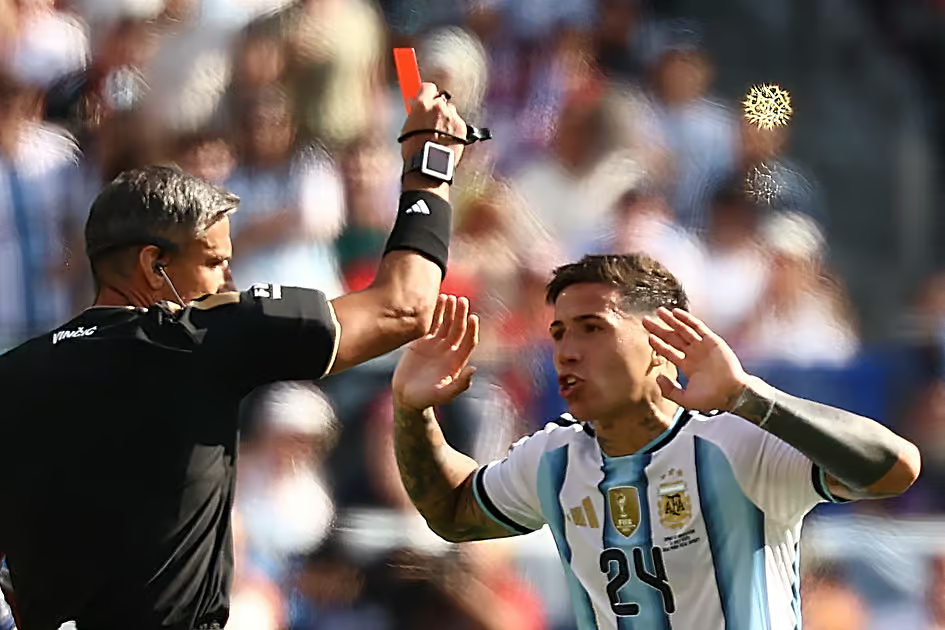
But in the final, Spain were too good as Argentina went into a shell, defending deep, committing a plethora of fouls in a desperate attempt to take the game to penalties.
Spain eventually won with a wonderful strike from second-half substitute Ferran Torres in extra time.
Argentina’s critics were up in arms again for their failure to put up a fight against Spain in footballing terms, while ridiculing their aggressive tactics and tackles to break the European champions’ rhythm in what was one of the most lopsided finals in World Cup history.
But Tim Vickery, a British journalist and a South American football expert who lives in Brazil, said that it’s acceptable in South America to show a battling spirit when you are up against a superior opponent.
“You have to use all of the weapons at your disposal to try and make life hard for the opponent,” Vickery said on his YouTube channel.
“And Argentine football really is beauty and the beast. When they get it right, there is no country that plays the ball better. They can play even better than Spain and Brazil. Argentine passing football, when it hits the spot, is incredible; all they want is to keep that ball rolling in beautiful rhythm.
“But when they’re up against it, and they really hate losing, and losing is just taken so much more seriously… The national football team is the biggest symbol of a nation (in South America), so losing a game feels like being invaded by barbarians who must be repelled by any means — foul or fair.
“Obviously, this plays very badly in the global spotlight, but I think there is an interesting debate to be had about what is a disgrace. Rolling over and losing easily — is that all right? Or really getting your fingernails and your toenails into the battle and fighting with everything that you have? That’s the South American way. And it does seem to rile a lot of people on the other side of the Atlantic, especially in England.”
Not the sole embodiment of negative football
While it was unfortunate to see only one team — Spain — play good football in the final, the sport’s history is littered with teams that fought with all their might against better sides to win matches.
The victorious Spanish team have earned admirers for their beautiful passing game — a footballing philosophy that was introduced in their system around 30 years ago at the grassroots level.
But in their club football, there have been numerous instances of teams playing aggressively and committing cynical fouls to gain an advantage.
Jose Mourinho’s Real Madrid team featuring Cristiano Ronaldo bullied their rivals in La Liga, especially Barcelona in the ‘Clasicos’, when defenders like Sergio Ramos and Pepe regularly crossed the line, even assaulting rival players in the middle of matches.
But the ugliest scenes from a game of football in Spain emerged after Barcelona played Athletic Bilbao in the 1984 Copa del Rey final when Diego Maradona, frustrated after repeated fouls on him by Bilbao defenders, especially Andoni Goikoetxea, kicked an opponent, which led to a huge brawl on the pitch with the King of Spain watching helplessly from the Royal Box.
Earlier in that season, Goikoetxea, who was known as the Butcher of Bilbao, broke Maradona’s ankle with an ugly tackle from behind, keeping the Argentine out of the game for several months.
Reportedly, Goikoetxea kept the boot with which he kicked Maradona and broke his ankle in a glass case at his home.
There has always been a dark side to football across all major countries — fans have seen all that and more, long before this Argentina team was built by Lionel Scaloni.
“Football is a contact sport. It’s physical by nature. If you cross the line, there are rules and punishments, and that’s fair,” Ferrari said.
“We can analyse whether Argentina were too physical at times (in the final against Spain), but people talk as if only Argentina played that way. Did they watch how Messi was treated every time he touched the ball (in this World Cup)? Even in the final, he was repeatedly fouled, and not every challenge was even given as a free kick.
“Near the end of the final, Rodri clearly fouled Messi on the edge of the penalty area. It was an obvious free kick. I saw the replay. But incidents like that are conveniently ignored because some people only see what they want to see.”
Not acceptable behaviour
As an Argentinian, Ferrari feels embarrassed to see the images of Leandro Paredes assaulting Spanish player Gavi after the final.
For him, Paredes’ behaviour is unacceptable. But what he also cannot accept is the narrative run by a lot of media houses in Europe that the Paredes incident reflects the mentality of the entire South American country.
“It’s unfair to take one player’s behaviour and use it to label the entire Argentina team or all Argentinians. That’s lazy journalism. One incident doesn’t define an entire nation,” he said.
“A few days earlier, after the Argentina-England match, Jude Bellingham struck an Argentine player from behind. Are we supposed to use that to describe the whole England team? Of course not. That’s not how fair analysis works.
“People should judge incidents individually instead of forcing them into a broader stereotype.”
Coming back to the football, despite the insipid display in the final, Ferrari said his countrymen would always be proud of the Argentina team.
“I don’t believe we played dirtier than Spain or England. Against England, Messi was constantly surrounded by three or four defenders every time he received the ball. He was kicked repeatedly in the second half when England were just trying to defend their lead. That’s football. Teams foul dangerous players. Sometimes you take a yellow card because that’s the only way to stop them,” he said.
“Nobody likes it. It’s not pretty. But it’s part of football. If you commit a foul, you accept the punishment and move on. That’s very different from pretending only one team plays physically.
“So, they can talk all day long, but we’re incredibly proud of this Argentina team. We accept that Spain were deserved champions. All we ask is for the same fairness when Argentina are judged.”
Source: Khaleej Times