

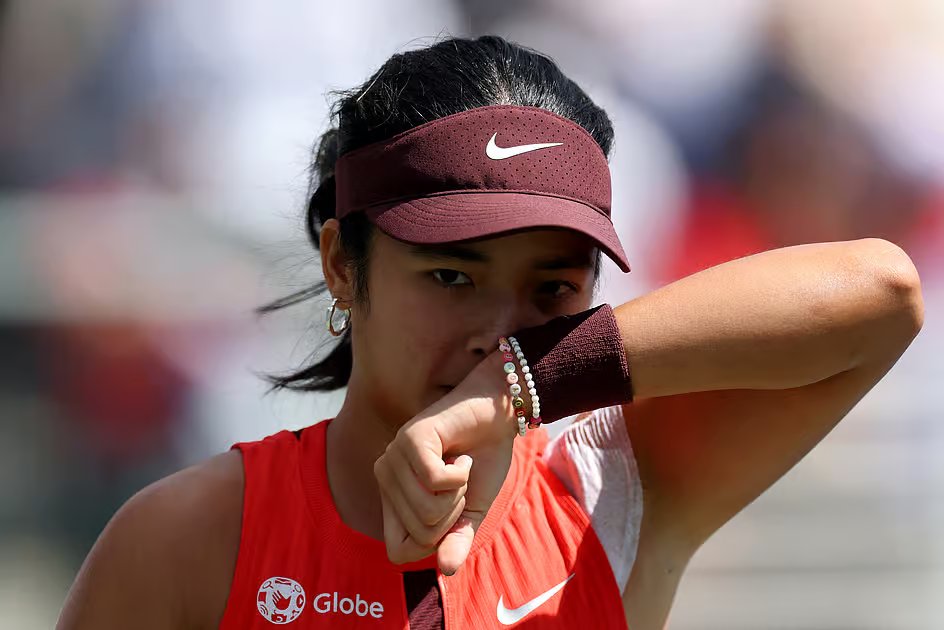
Back in 2010, when Roberto Maniego, the late Filipino sports enthusiast who took his four-year-old granddaughter, Alex Eala, to the tennis court for the first time, he probably had no idea that the moment could spark a historic transformation in the sporting landscape of his country.
Maniego’s constant encouragement had already inspired his daughters, Rizza, Alex’s mum, and Niki to become top swimmers, with the former winning a silver medal at the 1985 Southeast Asian Games in Bangkok.
But Alex Eala was destined to reach a far bigger stage — one that nobody could have envisioned.
Having risen through the junior ranks, Alex Eala left the Philippines at the age of 13 to join the tennis academy of her idol, Rafael Nadal, in Spain.
The feisty left-hander went on to capture the 2022 US Open junior singles title before launching an unprecedented march to the upper echelons of women’s tennis.
Last year, Eala became the highest-ranked player in the Philippines history as she stunned three Grand Slam champions on her way to the Miami Open semifinals.
The 20-year-old’s exploits on the big stage have now ignited an incredible passion for tennis in a country that has no history of producing world-class players.
The Eala craze has now reached fever pitch with her matches around the world bringing a huge number of Filipino fans to the stadiums, creating a football-like atmosphere.
Reportedly, the Women’s Tennis Association (WTA) is also enjoying a windfall after Eala burst onto the global stage, bringing a new demographic to the sport.
A journalist had recently announced at a press conference that Eala’s interviews, short video clips of her training sessions and fan interactions earn more views on the WTA website and its social media platforms than those of Grand Slam winners like Aryna Sabalenka, Iga Swiatek, and Coco Gauff, the three biggest names in women’s tennis now.
There is also a noticeable increase in youngsters joining tennis academies in the Philippines, a country in which basketball and boxing have traditionally been the most popular sports.
So as Eala, currently ranked 38, prepares for the French Open, which starts on Sunday, it’s intriguing to know if her inspiring journey can lay the foundation for millions of young Filipino tennis players.
Tough challenge
Riera Mallari, a veteran Manila-based sports journalist, has lowered the expectations of Filipino fans who may have dreamt of seeing more Eala in the next few years.
Mallari says there is no dearth of domestic tournaments in the Philippines, but they rarely offer the platform needed to produce top players.
“There has always been an interest in tennis, as there have been countless junior tennis tournaments all over the country. But the level of play has been stagnant because players get to take on the same faces over and over again,” Mallari said.
“With Eala, it was different. She levelled up and trained at the Rafa Academy when she was 13, and that was the key because she was able to raise her level of play under international coaches and against consistent international competition.”
But Eala’s success may lead corporate houses to invest in the sport
“Only the national team players, who are supported by the government (funding through the Philippine Sports Commission), get to taste international competition, but these are very few and far between. With Eala putting a spotlight on the sport, renewed interest is happening, and that is a good sign,” he said.
Spurred on by Eala’s big wins over elite players, the Philippines this year hosted its first-ever WTA tournament.
“Even though it was just a 125-level tournament, some Filipino players, Tennielle Madis and Steffi Aludo, who took part in the tournament, were recently taken in by the University of Hawaiʻi at Mānoa to bolster their women’s tennis NCAA team,” Mallari informed.
Unlike hundreds of young Filipino athletes who lack basic facilities, Eala was born into an affluent family in Quezon City.
“Her family supported her in training and in competitions which average Filipinos could not afford,” said Filipino journalist Ares P. Gutlerrez.
“There were also good tennis players who took the development path taken by Alex – they also trained in Spain – but they were not as fortunate as Alex, who arrived at the right place at the right time. But Alex’s successful run would surely get the big corporations’ attention and perhaps put their money back into sports.”
The Sania connection
When Alex Eala was born in 2005, India was witnessing the rise of a tennis sensation in Sania Mirza, who beat top-10 players, became the highest-ranked Indian woman in history and went on to win multiple Grand Slam titles in doubles and mixed doubles.
But Sania’s story failed to spark a revolution in India’s women’s tennis, with the country still struggling to produce decent players.
And the Philippines, just like India, may find out soon that you cannot bank on one standout talent to establish a strong ecosystem.
“There is a difference between countries with a strong tennis tradition and countries without one, said Joan Solsona Magri, a Spanish tennis writer.
“Switzerland, for example, had two great champions in the same generation — Roger Federer and Stan Wawrinka — but now they do not have a single player in the top 100.
“Now compare Switzerland to countries like Spain, France, Australia or the United States. Regardless of whether they have a Grand Slam champion at a particular time, these countries will always have six or seven players in the top 100. They have the tradition, the infrastructure and the facilities that many other countries simply do not have.
“So to judge the health of tennis in a country, you need to look at how many players it has in the top 100. Having one Grand Slam champion is not necessarily an accurate reflection of the overall standard of the sport. You cannot produce a Federer or Wawrinka every five or 10 years.”
Magri echoed Mallari’s sentiments that unless countries like the Philippines or India start investing in youth to send their youngsters abroad for training, the likes of Eala or Sania cannot be copied.
“When you are born in a country without a strong tennis history or system, you usually need to move elsewhere to develop your game,” he said.
“That is what Alex Eala did. If she had stayed in the Philippines, she would not have become the player she is today. She had been at the Rafa Nadal Academy since she was 14. She would not have had access to those facilities or coaches in the Philippines.
“Her story is truly incredible — to see a youngster from the Philippines reach this stage. But it’s unrealistic to expect her success alone to transform tennis in an entire country. It takes far more than that.”
Source: Khaleej Times