

At Meydan Racecourse, the thunder of hooves tells an enduring story, one that began long before the majestic grandstand rose above the tracks.
As the Dubai World Cup approaches its 30th running, it marks the culmination of a remarkable journey that traces back decades to Dubai’s sandy stretches when horse-riding was little more than a shared passion among Emiratis.
Stay up to date with the latest news. Follow KT on WhatsApp channels.
Back when modern racecourses and official rules were still a general idea, Emirati riders tested their skills and horses’ speed in informal contests along the Al Mamzar shoreline and across stretches of open desert. These friendly rivalries between fearless young men riding bareback captured the spirit of the Bedouin relationship with the horse. Those humble contests found a home in the city at the old Metropolitan track.
In those early days, the ‘racecourse’ was little more than a sandy oval carved from the desert. There were no elaborate facilities, no spectators and no luxury hospitality suites.
On race days, officials famously borrowed weighing scales from Dubai International Airport to ensure jockeys carried the correct weight, a small but telling detail that illustrates how modest the beginnings truly were.
The foundations of modern racing in Dubai were laid in 1981 when the city staged its first organised Thoroughbred race meeting on a former camel race track. Only three races were run that day, but the event planted the seeds for a professional industry.
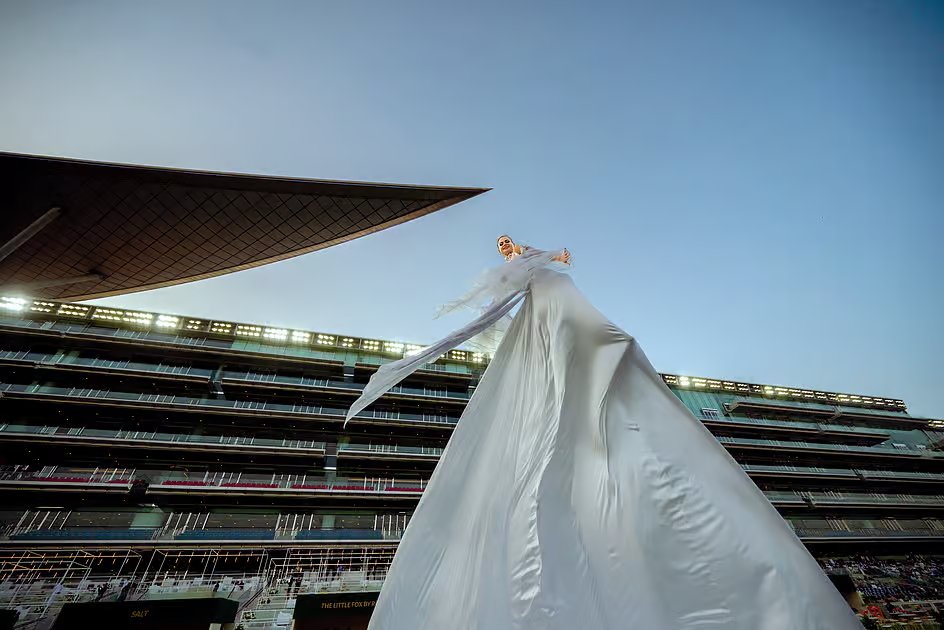
Traditional dance perform during the Dubai World Cup at Meydan Racecourse on Saturday 31, March 2018
A decade later, the sport took a major leap forward with the creation of the Dubai Racing Club and the opening of Nad Al Sheba Racecourse in 1992. Built on desert land on the outskirts of the city, Nad Al Sheba transformed what had once been informal sand-track contests into a professional spectacle. Its sweeping dirt and turf tracks, grandstand and expansive stables provided facilities capable of welcoming the world’s finest horses and riders.
When the Dubai World Cup was staged there for the first time in 1996, the racecourse instantly placed Dubai on the international racing map as the Emirate’s racing ambitions truly began to gallop.
If Nad Al Sheba represented Dubai’s arrival on the racing scene, its successor, Meydan Racecourse, symbolised racing’s leap into the future. Opened in 2010 on the same historic site, the vast complex redefined what a racecourse could be. It showcased a sweeping grandstand that could host more than 60,000 spectators, featuring a post-modern architecture. The venue’s gigantic crescent-shaped roof that arcs across the grandstand stretches roughly 426 metres in length and 56 metres in width. An engineering marvel, it is among the largest cantilevered roofs in sports architecture, appearing to float effortlessly above the Royal Enclosure, vast seating areas, Michelin-star restaurants and plush hospitality suites.
Thousands of solar panels are also integrated into the roof, generating around 750 kilowatts of electricity that supply the entire racecourse and underscore Dubai’s ambition to combine sporting spectacle with sustainable innovation.
Yet, for all its technological brilliance, the soul of racing in the Emirates remains deeply rooted in heritage. The Arabian horse, prized for endurance, intelligence and beauty, has shaped the region’s culture for centuries. That legacy remains, even as the sport becomes more modern and global.
Source: Khaleej Times