

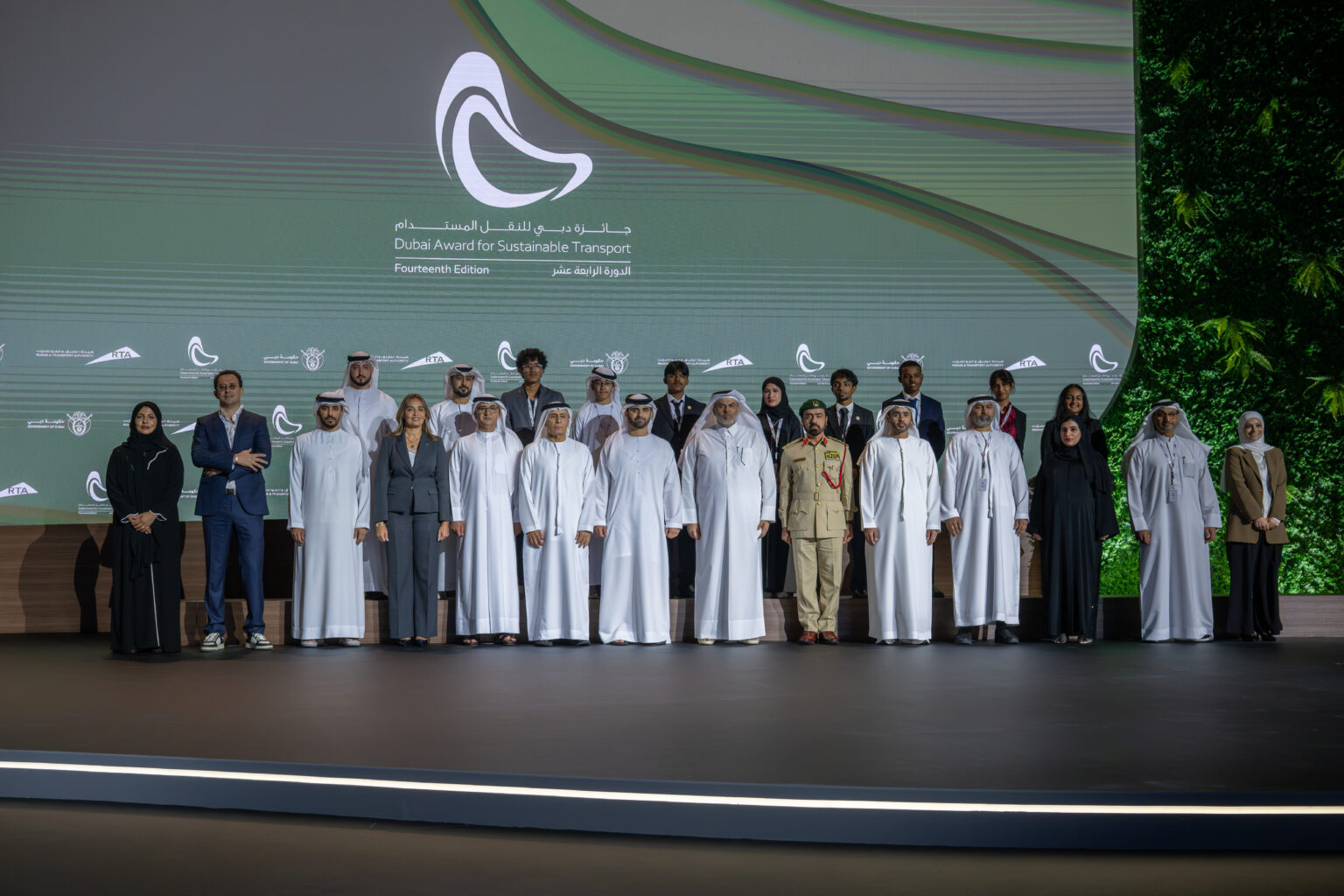
DUBAI, 15th October, 2026 (WAM) — Under the patronage of H.H. Sheikh Hamdan bin Mohammed bin Rashid Al Maktoum, Crown Prince of Dubai, Deputy Prime Minister and Minister of Defence of the UAE, and Chairman of The Executive Council of Dubai, H.H. Sheikh Mansoor bin Mohammed bin Rashid Al Maktoum, President of the UAE Olympic Committee, honoured institutions, entities and individuals who won the 14th Dubai Award for Sustainable Transport (DAST).
One of the initiatives of Dubai’s Roads and Transport Authority (RTA), the award seeks to advance the principles of sustainable transport and encourage government and private sector entities, as well as individuals, to adopt global best practices in sustainable transport, integration, and innovation and smart mobility, alongside innovative solutions that enhance safety and protect the environment.
H.H. Sheikh Mansoor was received on his arrival at the award ceremony at Dubai World Trade Centre by Mattar Al Tayer, Director General, Chairman of the Board of Executive Directors of the Roads and Transport Authority (RTA), along with dignitaries and senior officials from ministries, authorities, institutions, companies and entities participating in the award.
The Dubai Award for Sustainable Transport 2026 attracted more than 750 applications, marking a 400% increase. Of these, 158 applicants qualified for the final evaluation, representing a 140% increase. Entries were received from 45 entities in nine countries, alongside 460 individual entries from 22 countries, reflecting the award’s growing reach and the diversity of experiences showcased by institutions and individuals to advance sustainable transport.
H.H. and the audience also watched a film about the Dubai Award for Sustainable Transport. Shedding light on the role of sustainable transport in keeping pace with urban expansion and supporting economic growth, the film showcased RTA’s efforts to develop an integrated public transport system, smart solutions and environmentally friendly vehicles, and their contribution to reducing emissions, improving energy efficiency and enhancing quality of life.
Tony Seba, an entrepreneur, author and expert on technology disruption, delivered the keynote address titled ‘The Economics of Disruption and the Future of Transport.’ He explored the profound transformations reshaping the world as modern technologies advance at an accelerating pace and examined their impact on economic sectors and ways of life.
Seba explained that major transformations are driven by falling technology costs and faster adoption, citing forecasts he made in 2014 on the rapid growth of solar energy, lithium-ion batteries and electric vehicles, with these developments materialising faster than he had anticipated.
He said artificial intelligence and autonomous electric vehicles are set to fundamentally transform the transport sector through the emergence of a new model known as Transport-as-a-Service (TaaS), built around fleets of autonomous vehicles and opening far-reaching opportunities to reshape cities, businesses and commerce. Seba drew a parallel with New York City’s historic transformation between 1900 and 1913, when automobiles replaced horse-drawn carriages and fundamentally changed transport and urban life.
Seba added that the world is undergoing simultaneous transformations across energy, transport, food, materials and labour, creating exceptional opportunities to reshape economic and social systems. He noted that Dubai is at the forefront, with the strategic capabilities to lead these shifts and make a significant leap towards more advanced future systems, drawing on its ability to anticipate the future and embrace innovation and modern technologies.
Mattar Al Tayer, Director General, Chairman of the Board of Executive Directors of the Roads and Transport Authority (RTA), said the Dubai Award for Sustainable Transport embodies Dubai’s vision of making sustainability and innovation key drivers of transport and mobility development. He added that the award encourages government and private sector entities, academic institutions and individuals to develop high-impact solutions that help build more sustainable and resilient cities, enhance quality of life, and keep pace with the rapid transformations reshaping the global transport sector.
He said: “The significant growth in participation in the 14th edition reflects the award’s growing profile and its expanding role as a platform for exchanging best practices and experiences in sustainable transport. The diversity of the winning projects also reflects the sector’s rapid evolution and the use of modern technologies, artificial intelligence and clean energy to develop practical, scalable and deployable solutions.”
He also stressed the importance of investing in young people and harnessing their ideas to help shape the future of mobility. He noted that the participating student projects demonstrate a strong awareness of future challenges and an ability to apply innovation and modern technologies to develop solutions that combine sustainability, mobility efficiency, and quality of life.
H.H. Sheikh Mansoor bin Mohammed bin Rashid Al Maktoum, accompanied by Mattar Al Tayer, honoured winners across various award categories.
Greater Amman Municipality in Jordan won the Elite Award for its Bus Rapid Transit (BRT) project. The project provides an integrated public transport system that brings together BRT and Amman Bus services within a unified, safe, and accessible network, with integrated operations and fares. It serves all segments of society, including People of Determination and senior citizens, while helping ease congestion and reduce reliance on private vehicles.
The network comprises 193 buses operating across nine routes spanning 215 kilometres. The project has served 73.9 million passengers, averaging 2.1 million passengers per month. Phase Two will add more than 43 kilometres and three new routes serving the south and west of Amman.
Introduced in the 14th edition, the Elite Award is one of the award’s most prominent additions and represents its highest level of distinction. The winner is selected from among first-place entries across the various categories, excluding the student awards, based on the project’s impact, sustainability and level of excellence. The winner receives a special trophy and a cash prize of $100,000.
In the Sustainability category, the Integrated Transport Centre (Abu Dhabi Mobility) won the Pioneering Sustainable Cities Award for its Integrated Regulatory Framework for Sustainable and Inclusive Transport. The framework brings together policies, legislation, standards and digital compliance procedures governing micromobility, low- and zero-emission vehicles, autonomous vehicles, urban logistics, and inclusive public and school transport for People of Determination. The Ministry of Energy and Infrastructure secured second and third places for the Railway Law and the National Transport Strategy, respectively.
Etihad Rail won the Outstanding Sustainable Fleet Award for its Etihad Rail Modal Shift project, which connects ports with industrial and commercial centres through a high-capacity network, helping reduce emissions and strengthen supply-chain resilience. DP World secured second place for Electrification of DP World Port and Terminal Fleet, while Dubai Taxi Company secured third place for Dubai Taxi Company Sustainable.
Keeta Drone won the Clean Energy for Mobility Award for its ‘Delivery in Dubai’ initiative, which provides delivery services for food, medicines, and essential goods while reducing delivery times and limiting the use of combustion-engine vehicles on short journeys. Sharjah Taxi secured second place for Environmentally Friendly Vehicles, while Legend Motors secured third place for Sustainable Mobility Solutions.
Emarat EV Charging Stations Company PJSC (UAEV) won the Urban Changemakers Award for its UAEV – EV charging network, which provides access to fast-charging services through the design and operation of a public network, with charger locations determined by actual usage patterns. Qatar’s Ministry of Transport secured second place for the Lusail Bus Depot, while Abu Dhabi Mobility secured third place for its Green Bus Assessment Programme.
In the Inclusivity category, the Ministry of Energy and Infrastructure won the Urban Flow Improvement Award for its Resilient Transport for Crises and Congestion project. The project links existing smart assets to an artificial intelligence platform and uses digitised alternative routes and temporary bridges to maintain smooth and continuous traffic flow during crises. Dubai Municipality secured second place for Smart Mobility for Field Employees, while Dubai Government Workshop secured third place for Traffic Flow with Limited Road Capacity.
Dubai Police General Command won the Safe Transport Award for Safe Cycling in Dubai, which combines awareness, field enforcement, and community partnerships to improve the safety of bicycle and e-bike users and reduce accidents and injuries. Dubai Taxi Company secured second place for Tendered RTA DTC Fleet Safety, while Abu Dhabi Mobility secured third place for Waterways Signage Enhancement.
Careem won the First and Last Mile Award for Careem Bike, which connects users to metro, bus and tram stations and key destinations through shared electric bicycles and solar-powered docking stations, reducing reliance on cars for short journeys. United Trans secured second place for its Bus-on-Demand Dubai service.
Morocco-based Enakl won the Transport for All Award for its Access to Skills initiative, which provides accessible and reliable shared transport for learners and young people travelling to explore vocational training opportunities. A digital platform plans journeys around users’ needs, expanding access to training and employment opportunities while reducing mobility barriers.
In the Innovation category, Qatar’s Ministry of Transport and the Dubai Civil Aviation Authority jointly secured first place in the Best (AI) Innovation in Transport Award, which in the 14th edition focused on artificial intelligence in transport.
Abu Dhabi Mobility secured second place for Marsadna, while Dubai Police secured third place for its Smart Escort for Explosives Shipments initiative.
Qatar’s Ministry of Transport presented the Qatar Activity-Based Model (QABM), which simulates real-world travel behaviour among individuals and households and brings different modes of transport together within a unified framework to support infrastructure planning and the testing of future policies.
The Dubai Civil Aviation Authority presented the DMS AAM Integration Platform, which manages and monitors advanced air mobility operations and integrates airspace management, operator compliance, security coordination and operational records within a unified digital ecosystem, supporting the safe and efficient operation of advanced air mobility services.
Yousef Al Badawi of Ajman University secured first place in the NextGen for Mobility Award for Smart Solar Pedestrian Nodes. The project combines solar shades, artificial intelligence and atmospheric water-harvesting technologies at pedestrian crossings, providing shade and adjusting crossing times according to crowd density and the needs of People of Determination.
Lauren De Souza of Middlesex University Dubai secured second place for Koko’s Day Out, an interactive sensory book designed to help children with autism aged 6–12 prepare to use public transport in Dubai.
Abdulrahman Mohammed Al Raisi of Hamdan Bin Mohammed Smart University secured third place for Smart Energy-Generating Speed Bumps, which convert kinetic energy generated by passing vehicles into electricity and use artificial intelligence and the Internet of Things to analyse traffic and improve road operating efficiency.
In the Outstanding Student Solutions Award, Shamas Abdulraouf of The Indian School – Abu Dhabi secured first place for Empty Miles, an AI-powered platform that matches available capacity in commercial vehicles with transport demand, reducing empty trips and emissions while improving vehicle utilisation.
Ali Al Ali of Al Rushd American School – Sharjah secured second place for Bio-Smart Transit Hubs, which uses microalgae, artificial intelligence and solar energy to purify the air at bus stops. Muheirib Hussein of Gulf Ocean School – Dubai secured third place for Project Phantom, an environmental monitoring platform that uses a drone equipped with sensors and intelligent data-analysis systems.
Winners of the NextGen for Mobility Award and the Outstanding Student Solutions Award receive cash prizes of AED60,000 for first place, AED40,000 for second place, and AED20,000 for third place, along with a certificate from His Excellency the Director General, Chairman of the Board of Executive Directors.
The Dubai Award for Sustainable Transport aims to encourage greater participation by institutions and individuals in developing solutions that provide safe, accessible and sustainable transport for all. It also seeks to strengthen public awareness of mobility, safety and environmental issues, encourage creativity and practical initiatives in these areas, and enhance cooperation between RTA and its partners in the government and private sectors, alongside the exchange of expertise and practices that support the sustainable transport ecosystem.
The award is open to institutions, government entities, private sector companies and individuals, as well as university and school students, encouraging them to submit projects and initiatives that address mobility challenges and support the development of sustainable and innovative solutions.
The 14th edition of the award attracted entries from government entities, companies and individuals. The winning projects featured distinguished initiatives from the UAE, Jordan, Qatar and Morocco across transport regulation, clean energy, traffic safety, mobility integration, artificial intelligence and student-led solutions.
Entries were assessed by an accredited judging panel chaired by Dr. Yousef Mohammed Al Ali and comprising specialists and experts in engineering, urban development, transport safety, the environment and research methods. Panel members were drawn from universities and academic and professional institutions, including United Arab Emirates University, American University of Sharjah, Birzeit University, the Higher Colleges of Technology and the International Association of Public Transport (UITP), alongside specialists from RTA.
The award’s Supreme Committee develops and updates the award guidelines, evaluation criteria and their respective weightages, oversees the receipt, classification and referral of entries to the evaluation team, and coordinates with the judging panel to determine the winners and submit the results for final approval.
The judging panel selected the Elite Award winner from among first-place entries across the award categories, excluding the student awards, after reviewing the winning projects and assessing their impact on sustainable transport to identify the initiative that achieved the greatest sustainable impact.
Source: Emirates News Agency