

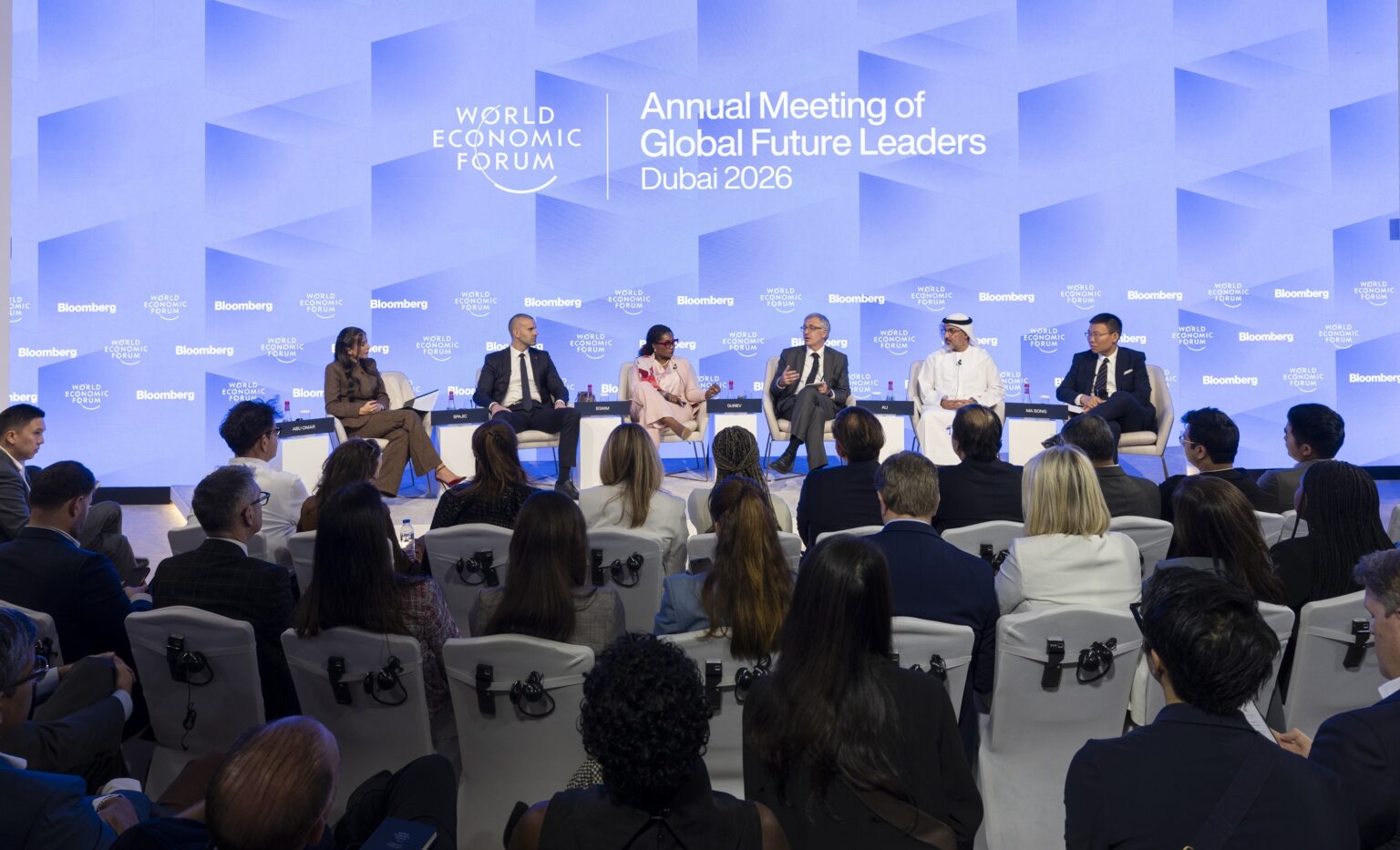
DUBAI, 14th October, 2026 (WAM) — Officials and experts at the Annual Meetings of the Global Future Councils in Dubai said the future of finance and responsible AI adoption will depend on collaboration, effective governance and public trust in their contribution to sustainable development.
Organised through a partnership between the UAE Government, the World Economic Forum and the Dubai Future Foundation, the Meetings featured “Economics after Certainty,” where Milojko Spajic, Hamed Ali, Sergei Guriev, Ma Song and Chinwe Egwim highlighted risk forecasting and management as central to future economic policy, sustainable growth and resource protection.
Milojko Spajic, Prime Minister of Montenegro, stressed the need to strengthen competitiveness, attract investment and accelerate technology adoption amid inflationary pressures and a growing tax burden on businesses. He said uncertainty requires lower risks and costs, stronger resilience and readiness for future challenges, citing the UAE as a pioneering global model.
Hamed Ali, CEO of Dubai Financial Market, said, “We double the size of our economy in the UAE every ten years because we have embraced economic diversification. We have become a leading global hub that attracts investment and long-term partnerships, and a bridge between East and West.” He said rapid global change requires clearer forecasts, stakeholder engagement and diversified financial tools, urging institutions to remain agile and turn challenges into opportunities.
Sergei Guriev, Dean of London Business School, UK, said markets are seeking safe assets amid economic volatility. He suggested GDP may eventually give way to indicators showing how people benefit from growth, while tackling inflation requires clear targets and integrated, flexible strategies. He concluded, “I am optimistic that humanity will find a way to create new jobs in the age of artificial intelligence.”
Ma Song, Professor of Finance and Entrepreneurship at Yale University, USA, identified four dimensions of AI uncertainty: physical, reflecting its rapid rise and opaque processes; psychological, concerning its use; regulatory, involving governance; and political, driven by government concerns. He said technology transforms global conditions but must strengthen meaning in people’s lives, adding: “The world will continue to change, and we must develop plans to address the risks arising from its constant transformation.”
Chinwe Egwim, Chief Economist at First Bank of Nigeria, said market models have increasingly incorporated risk forecasting to navigate uncertainty as global conditions shape inflation. She emphasised flexible forecasting, evolving financial models and stronger local value creation as foundations for sustainable growth and data-led financial resilience.
In “Betazone: the human – machine line,” Madeline Gannon, Founder and Principal Researcher at Atonaton, said interaction with robots and physical AI will move from screens to direct engagement, with trust underpinning human-machine relationships. She said societies can shape automation, while intelligent machines require constructive communication because greater autonomy can reduce direct human control.
Gannon remained optimistic while stressing responsible development. Fear, she said, should not stop societies directing technology towards beneficial uses: “Humanoid robots attract considerable attention, but the future may see artificial intelligence embedded in everyday environments and tools, making technology more integrated into daily life and less tied to the conventional form of the robot.”
For his part, Ambarish Mitra, Co-Founder of Greyparrot, said robots must understand their environments and make informed, data-based decisions. AI and robotics should complement—not replace—human capabilities by improving efficiency and systems. Innovations are already transforming industry, waste management and supply chains, but receive less attention than humanoid robots and other visible applications.
Source: Emirates News Agency