

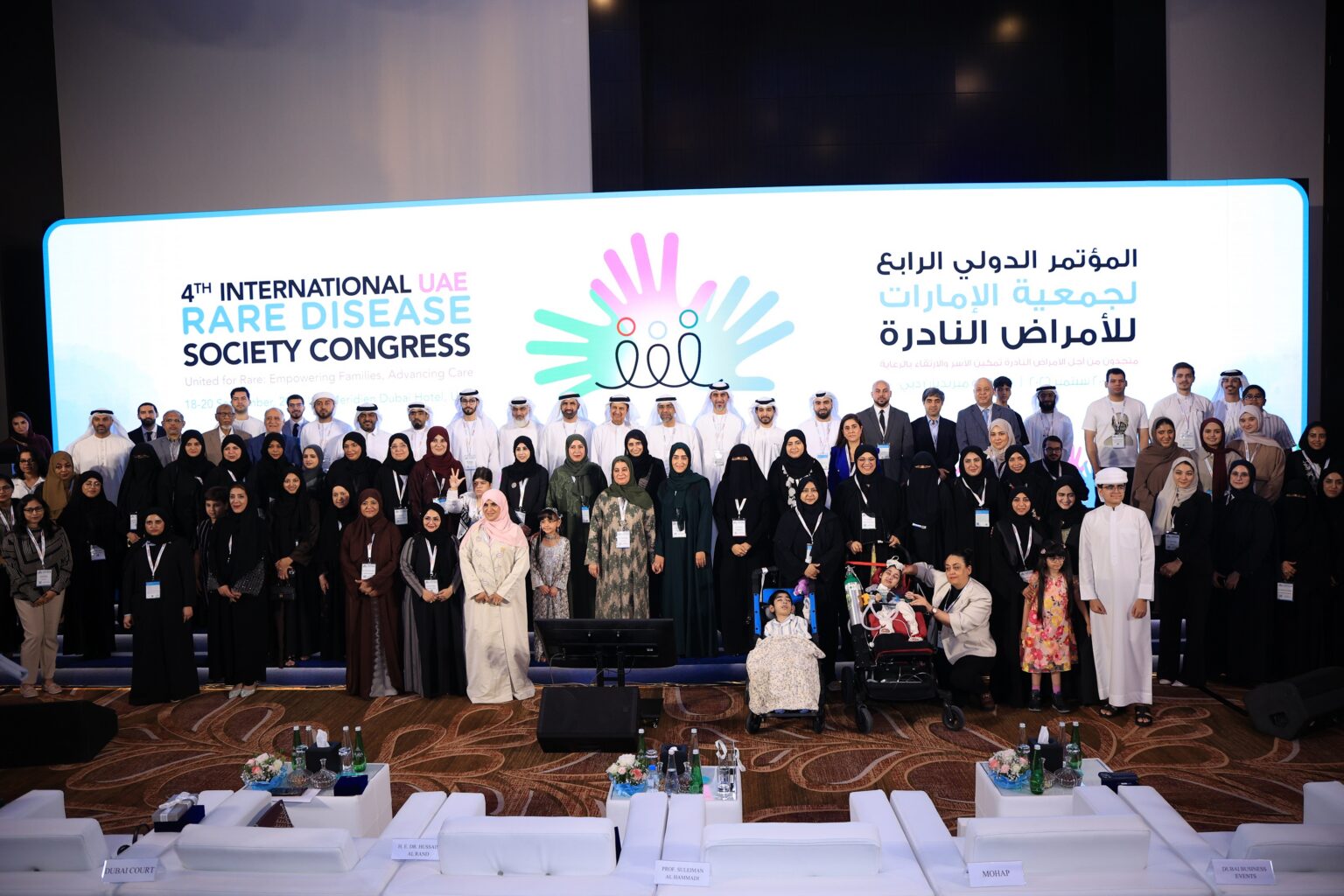
DUBAI, 19th September, 2026 (WAM) — The UAE Rare Disease Society announced that the Society has successfully won the bid to host the International MPS Network (IMPSN) Conference in 2028.
”The UAE will become the first country in the Middle East and North Africa to host this distinguished event – a historic milestone that reflects the nation’s growing leadership in rare disease care, scientific research and international collaboration,” Dr. Noha Al Zaabi, President of the 4th International UAE Rare Disease Society Congress, Consultant in Genetic and Metabolic Disorders, and Board Member of the UAE Rare Disease Society, said at the official opening of the 4th International UAE Rare Disease Society Congress in Dubai today.
She said: “The 4th International UAE Rare Disease Society Congress is more than a scientific event; it is a platform for hope, partnership and action. By bringing together healthcare professionals, researchers, policymakers, patients and their families, we can translate knowledge into earlier diagnosis, better treatments, stronger support systems and a brighter future.”
Dr. Al Zaabi noted that the Congress features two principal tracks: a scientific track and a family track. Its programme brings together more than 70 speakers and session chairs, including 15 international speakers, and features approximately 43 lectures, nine scientific and family workshops, and six specialised symposia. These diverse sessions reflect a commitment to combining scientific excellence with the lived experiences, needs and voices of patients and their families.
Dr. Hussein Al Rand, Assistant Undersecretary for the Public Health Sector at the Ministry of Health and Prevention, affirmed that the UAE’s wise leadership has placed growing emphasis on developing an advanced healthcare system built on prevention, early diagnosis, precision medicine and the use of modern genomic technologies. These efforts contribute to improved health outcomes and quality of life, particularly for people living with rare and inherited diseases, which require an integrated, multidisciplinary approach.
Speaking at the official opening of the event, Dr. Al Rand said that the Ministry of Health and Prevention is committed to supporting national efforts to prevent and detect inherited diseases at an early stage and to strengthen genetic screening and counselling services. This includes further developing the premarital genetic screening system, supporting newborn screening programmes and enhancing diagnostic capabilities in line with the rapid advances in genomic and personalised medicine.
He added that the Congress holds particular significance because its scientific programme addresses topics that reflect the major transformation taking place in the field. These range from premarital genetic screening and newborn screening using advanced sequencing technologies to sophisticated laboratory diagnostics, innovative therapies and gene therapy. The programme also examines metabolic diseases, treatable disorders, the ethics of genetics and the interpretation of genetic test results.
He explained that scientific progress in rare diseases is creating new opportunities for patients and their families that were not previously available. Realising the full benefit of these advances, however, requires stronger links between scientific research and clinical practice, earlier diagnosis, clear referral pathways, empowered healthcare professionals, and closer collaboration across the health, academic, research and social sectors.
He noted that care for people living with rare diseases extends beyond diagnosis and treatment to the entire family. This underscores the importance of empowering families, providing psychological and social support, promoting the inclusion of people of determination in society, and ensuring their access to appropriate health and social services. The Congress programme accordingly dedicates space to family-led initiatives, support programmes for people of determination, quality of life and the latest therapeutic advances.
He reaffirmed the Ministry’s belief that addressing the challenges posed by rare diseases requires a sustainable national partnership bringing together health and government entities, the academic and research sectors, healthcare providers, public-benefit associations, patients and their families. Such collaboration will help build a more integrated and sustainable ecosystem and translate scientific progress into a tangible difference in patients’ lives.
He added that the Congress provides an opportunity to exchange knowledge and expertise, build new bridges for collaboration, and look ahead to a future in which the possibilities for diagnosing, treating and preventing rare and inherited diseases continue to expand. Bringing together leading experts, specialists, partners and families under the theme “United for Rare: Empowering Families, Advancing Care,” the Congress serves as an important scientific and humanitarian platform.
Nafisa Tawfiq, Chairperson of the UAE Rare Disease Society and Chair of the Organising Committee, said that the Society serves as a bridge connecting rare disease heroes and their families with decision-makers, healthcare providers, supporting entities and the wider community.
She added that, in conjunction with the UAE’s Year of the Family, the Society’s family programme focuses on quality of life, government services, premarital genetic screening and family support, alongside the launch of new support and advocacy groups and the strengthening of international partnerships.
The second day of the Congress featured several main sessions and workshops addressing inherited metabolic diseases in adolescents. Participating experts and specialists highlighted the transition from paediatric to adult metabolic care, the need for long-term follow-up, and the importance of recognising late-presenting symptoms and multisystem complications.
A dedicated session on premarital genetic screening in the UAE examined its medical, societal and legal dimensions, as well as informed prevention, counselling and support for the decisions of couples preparing for marriage, while respecting individual rights and privacy.
The programme also reviewed recent advances in understanding, diagnosing and managing rare diseases and acute episodes, as well as new treatments that target underlying disease mechanisms and reduce the recurrence of symptoms and their impact on patients’ lives.
It highlighted the latest laboratory tools that enable faster and more accurate detection of rare diseases and help shorten and improve the diagnostic journey by integrating advanced technologies with clinical interpretation. Discussions also covered the shift from supportive care to targeted interventions based on disease mechanisms, including molecular, genetic and enzyme-based therapies.
The Congress showcased the efforts of Morocco’s Sawt Al Qamar Association in supporting children with xeroderma pigmentosum and their families, highlighting the importance of community action in raising awareness, providing protection and turning daily challenges into initiatives that inspire hope.
Participants shared personal experiences of moving from inclusion to active participation and professional and community achievement, stressing that inclusive policies and equal opportunities can transform challenges into influential leadership. A moving personal story illustrated the courage of a child and family confronting a rare disease, giving attendees a deeper understanding of everyday needs and of the impact that inclusion and sustained support can have on quality of life. Discussions emphasised that identifying a disease is the beginning of an integrated care plan and underscored the importance of medical follow-up, family counselling, psychological and educational support, and connecting families with appropriate services and resources. The programme also explored how a difficult personal experience can lead to a technological innovation that enhances the safety of children and people of determination, highlighting the family’s role in developing practical solutions to genuine needs and giving caregivers greater peace of mind.
The second day also presented the Ministry of Family’s system of programmes and services for people of determination and their families in the UAE, including assessment, support and coordination pathways that promote independence, inclusion and quality of life. The programme reviewed examples of social services provided by the Emirate of Sharjah for people of determination, emphasising integration between social care, families and institutions to ensure continuity of support across different life stages.
It also examined protection and response mechanisms for cases at risk, the importance of early reporting and multi-agency action, and the need to place the child’s best interests and dignity at the heart of every intervention.
Sessions addressed the quality of health services and the ability of individuals and families to participate and thrive, recognising prevention, awareness and community partnerships as essential pillars of a healthier and more inclusive society. Practical tools were also introduced to help patients and families use artificial intelligence to organise information and formulate more precise questions in support of dialogue with medical teams. In addition, the social, health and practical dimensions of marriage for people of determination were discussed, with a focus on strengthening rights and autonomy and identifying the forms of support that can help build stable and secure families.
The 4th International UAE Rare Disease Society Congress continues from 18 to 20 September at Le Méridien Dubai under the theme “United for Rare: Empowering Families, Advancing Care.” The Congress opened with specialised workshops, followed by scientific and family sessions.
Held under the patronage of the UAE Ministry of Health and Prevention, the Congress brings together leading experts, physicians, researchers, specialists, patient advocates and families from the UAE and around the world to exchange expertise and review the latest developments in rare disease diagnosis and treatment.
Source: Emirates News Agency