

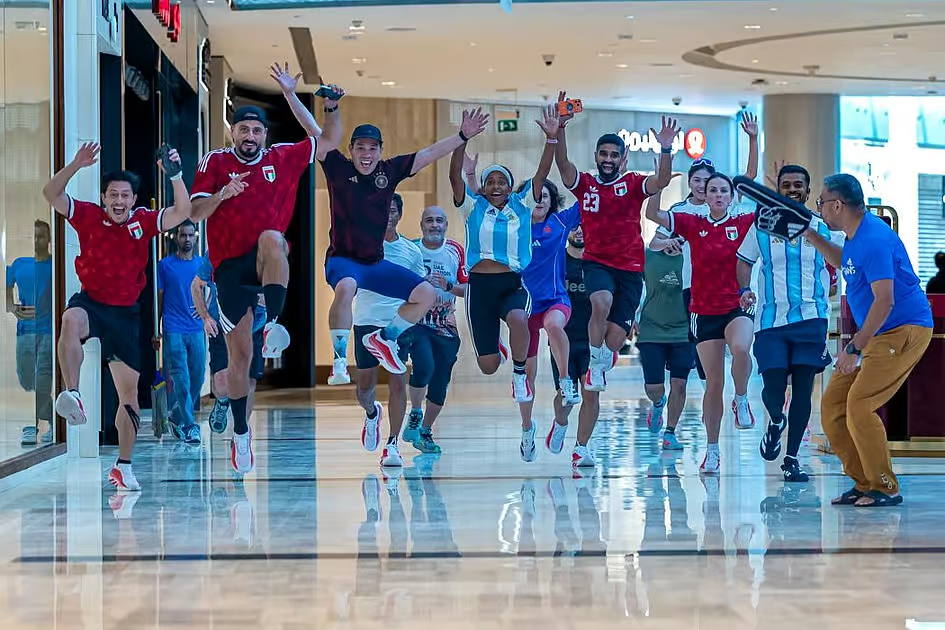
Summer is traditionally the quiet season for outdoor runners in the UAE. But this year, Abu Dhabi’s running community has found an unusual way to stay moving. Inspired by the Fifa Club World Cup, runners formed national teams, competed for kilometres instead of goals and, in some cases, pushed themselves to extraordinary distances despite the heat and humidity.
The two-week competition, organised by Adidas Runners Abu Dhabi, encouraged members to motivate one another to log every possible kilometre.
“We wanted to leverage the collective excitement of the World Cup season to energise our running community,” said Captain Rohit Kumar, head coach of Adidas Runners Abu Dhabi, who created the challenge alongside Master Jayson Castillo. Teams of four represented competing nations, logging their daily mileage through the Adidas Running app, while team captains verified every run. To keep the competition alive until the end, no teams were eliminated, regardless of the football tournament’s results.
Stay up to date with the latest news. Follow KT on WhatsApp Channels.
What surprised organisers most was not the distances, but how quickly the format changed the way people trained. “The level of accountability and camaraderie was incredible,” Rohit said. “The challenge completely transformed solo running into a collective team effort.”
Instead of training alone, runners coordinated schedules, wore matching team jerseys and met regularly at Adnec’s indoor track (Abu Dhabi Summer Sports) to complete indoor sessions together, with many covering between 20km and 30km in a single visit.
Predict your champion with the Khaleej Times Fifa World Cup simulator
As the competition gathered pace, runners embraced the World Cup theme, turning up to sessions in their team’s colours and following the leaderboard with the same intensity as football fans tracking tournament standings.
The final standings exceeded even the organisers’ expectations. The winning team amassed an astonishing 1,036km in just two weeks, an average of around 250km per runner, while second place finished only 60km behind. Third and fourth places were separated by just four kilometres, making for an unusually close finish.
From fifth-floor walk-ups to 100km runs
For some runners, the challenge became more than a friendly competition, it became a chance to discover just how far they could push themselves.
Among them was Omran Shkair, a 41-year-old chief electrical engineer who covered around 330km over the two-week challenge, helping his team, Morocco, finish second with approximately 972km.
Remarkably, he only took up running four years ago after joining a local running group in Abu Dhabi.
Growing up in the hilly countryside of Sweida in southern Syria, however, he believes the foundations were laid much earlier.
“Our life back then was physically demanding,” he said. “We lived on the fifth floor without a lift, and in the summer, I used to work on the family farm. I didn’t realise it then, but that gave me a strong base.”
After years spent behind a computer in an engineering job, Shkair turned to running as an escape from the mental demands of office life.
“My work is all on the computer,” he said. “It’s mentally exhausting. Running became the balance I needed.”
The sport quickly evolved from casual jogging into marathon running, then triathlons and, eventually, ultramarathons.
During the World Cup challenge, he completed the longest individual run of the competition, a 100km effort that took about 13 hours.
“I’ve always loved challenges,” he said. “Once you realise you can finish 100 kilometres, you start asking yourself, ‘Why not something bigger?’”
Through the night to Dubai
One of Shkair’s most memorable training sessions saw him run from Abu Dhabi to Dubai overnight.
He set off around 4pm and ran until about 7am the following morning, covering the distance largely in darkness before returning home by car.
Having completed the route once before without any support, this year’s attempt was made alongside fellow runner Mahmoud Al Khatib, who accompanied him with a support vehicle.
“There weren’t many people around,” Shkair recalled. “It was quiet.”
Despite the physical demands, he said the biggest battle during ultra-distance running is often mental.
“There comes a point where your motivation drops and you start questioning yourself: ‘Why am I doing this’?” he said. “But when you know you’re getting closer to the finish, the excitement comes back.”
He also discovered new landscapes and terrain details on foot, compared to crossing the highway by car.
The challenge reinforced one lesson above all others. “The mind plays the biggest role. Once you truly believe you can do something, you’re capable of much more than you think,” he concluded.
Rediscovering a passion
For Subhash Zinjad, the World Cup challenge rekindled a love for long-distance running that had faded over the past two years.
The 40-year-old proposals manager contributed around 320km to Team Mexico’s winning total of 1,036km, but admits he had not expected the competition to become so intense.
“What started as just another running challenge gradually became much more competitive,” he said. “Every day we were checking the leaderboard, calculating the gap and figuring out how many more kilometres we needed.”
As the standings tightened, him and his teammates: Vijesh Thampi, Mohamed Firnas and Farah Chahma, found themselves constantly adapting their strategy.
“We started planning our runs around the leaderboard,” he laughed. “If another team added more kilometres, we’d message each other and say, ‘We need to go out again tonight.’”
The final days became especially frantic. Team members headed straight from work to Adnec, where they ran together for hours before some continued outdoors later in the evening.
“I ended up doing around 30 kilometres that day,” Zinjad said. “We really wanted to make sure we stayed on top.”
The challenge also helped him rediscover the joy of longer distances.
“I hadn’t been running marathons much over the past couple of years,” he said. “This challenge gave me the motivation to come back.”
More than the kilometres, however, he says it was the camaraderie that stood out.
“Everyone was encouraging each other. Even though we were competing, there was a great atmosphere across all the teams. It pushed all of us to become better runners.”
More than a competition
Rohit believes the challenge’s biggest success was not the leaderboard but the sense of community it created.
Among the highlights were three runners completing marathon distances or longer during a single training session, including one participant who completed his first-ever marathon after previously never running beyond a half marathon. On the final day, dozens of runners even used their workplace half-days to head straight to Adnec, logging four to five hours of continuous running before the competition closed.
While most of the heavy mileage was completed indoors at Adnec, Rohit said that was intentional.
“The credit goes entirely to the UAE government, the Sports Council and Adnoc. Providing a world-class indoor venue like Adnec is an absolute game-changer for the local running community,” he said, adding that coaches encouraged runners to complete their longer sessions indoors while limiting outdoor runs during peak summer conditions. Co-organisers Kara Bello, Rami Hammadi and Joanna Budair played a big role in supporting the teams and executing the challenge, he added.
Following the success of the World Cup challenge, Adidas Runners Abu Dhabi plans to make the concept an annual fixture, adapting it each year around major sporting events and community initiatives.
For participants, however, the biggest victory was not measured in kilometres.
It was proving that even during the UAE’s hottest months, a little creativity, and a lot of teamwork, could turn one of the toughest times of year for runners into one of the most memorable.
Source: Khaleej Times