

There was a moment in Argentina’s first game against Algeria in this World Cup that could well emerge as one of the most powerful symbols of hero adulation.
Play and predict your Fifa World Cup 2026 champion here
This wasn’t from the playbook of Michael Jackson’s 90-second motionless stand before the start of his 1993 Super Bowl performance, when his silent pause sent the crowd into a state of frenzy.
Rather, it came from a football match — a still image which showed Lionel Messi, after an age-defying performance, slowly walking towards the corner flag with his head down.
Captured from the upper tiers of the stadium, Messi looks small against a sea of blue-and-white in the stands.
At 39, he had just become the oldest player in World Cup history to score a hat-trick.
But in that moment, there was no goal to celebrate.
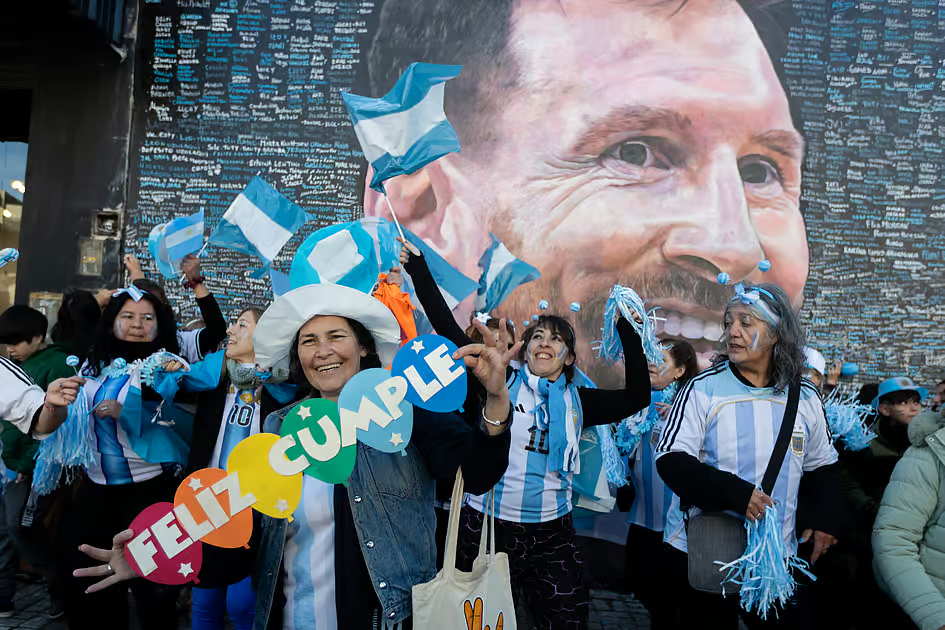
Instead, what those fans in that frame were celebrating was something far bigger than a goal — a sense of gratitude for being in the presence of a man who has become a living symbol of national pride.
What struck me the most about the picture is that Messi keeps his head down, the way his elementary school teachers in Rosario, his hometown in Argentina, described his demeanour as a shy student who would rarely make eye contact with anyone.
It was only with the ball that he had the most intimate conversations.
Nothing about him as a person changed even after he became a football phenomenon at Barcelona, scoring goals and breaking records with his dexterous talent.
But back home, he was never able to connect emotionally with the Argentine public, who found him too reserved, lacking the charisma of their idol Diego Maradona.
For more than a decade, Messi’s failure to replicate his Barcelona form in the Argentina jersey only compounded the problems.
After each failure to win a major international trophy, the frustrations grew in Argentina, with critics even questioning his commitment to the Argentinian cause.
It came to a point where Messi could no longer stand the toxic relationship, as he announced his retirement after Argentina’s third straight defeat in a major final in 2016.
He came out of retirement a few months later, but success eluded him until the 2021 Copa America, when he led the team to its first triumph in a major tournament since 1993.
“From that moment when Argentina beat Brazil in the Copa final at Maracana in Rio, Messi and the public started to feel at home in each other’s company.
By then he was also turning into a leader who was more expressive — not quite Maradona’s raw emotions, but bold enough for a verbal duel with an opponent on the field.
This is the sort of character Argentinians love to see in their heroes — icons who wear their hearts on their sleeves.
When Messi’s late surge with Argentina continued at the 2022 World Cup in Qatar, it was no longer a case of accepting him wholeheartedly. With each battle after their shock defeat to Saudi Arabia in the opening game, the little magician grew into a folk hero.
On the eve of the final, the fans were no longer demanding a World Cup trophy from him. They dreamt of winning the final, but a defeat would not have sent Messi back into a dark corner where he feels suffocated.
As Argentina prepared for the final against France, Messi was already the beating heart of his country.
There was the famous interview by celebrated Argentinian sports journalist Sofia Martinez. Instead of asking him a question for the final battle, Martinez looked into Messi’s eyes in the media mixed-zone and thanked him profusely for defending the nation’s honours.
“There’s no kid who doesn’t have your team shirt,” she told Messi. “No matter if it is a fake, real or made-up one. Truly, you made your mark in everyone’s life, and that to me is beyond winning any World Cup.”
Messi and his team did win the World Cup, beating France in a nerve-racking final to end Argentina’s 36-year wait for the famous trophy.
On that night of December 18, 2022, Messi achieved something nobody ever thought was possible — he grabbed an equal share of space with Maradona in the public consciousness.
To do that in Argentina, to be equal to Maradona, who emerged from the poverty-stricken streets to become a folk hero, is even bigger than winning multiple World Cups.
Now, as Messi lights up the 2026 World Cup, their fans in the US and back home in Argentina don’t expect him to perform miracles anymore.
They just want to enjoy every moment of the last dance.
Argentina is now liberated from the pressure of a World Cup victory, and that little boy from Rosario is back to doing what he loved doing when he was just four — playing with the ball at his feet, dancing past defenders to score or create beautiful goals.
Nicolas Tapia, a musician from Mar del Plata, says the mood in the country has unmistakably changed.
“The atmosphere here in Argentina is fantastic. Of course, people here are hoping Argentina can win again, but they are far more relaxed than in previous tournaments,” the 37-year-old musician says.
“They have already seen the team lift the World Cup for the first time in 36 years, and they have seen Messi achieve his dream. The pressure is gone now. People are simply enjoying the journey.
“There is also a strong emotional element because everyone knows this is almost certainly Messi’s last World Cup. Fans are trying to savour every moment.”
The turnaround in Messi’s fortunes in Argentina is truly the stuff of legends.
For Jorge Ferrari, a Sharjah-based Argentinian expat, it feels like a fairytale.
“I remember watching him at the Under-20 World Cup when people were already calling him the new Maradona. You could see immediately that he was a brilliant talent. But what always struck me was how unfair some of the criticism was. People expected perfection from him all the time,” Ferrari says.
A sports photographer, Ferrari is still baffled by people who once even questioned his passion for the national team.
“Messi moved to Spain when he was just 13 years old and spent most of his life there. Yet even today, he speaks with an unmistakably strong Rosario accent,” he says.
“For years, some critics claimed he was more Spanish than Argentinian and cared more about Barcelona than the national team. But if you listen to him speak, it’s impossible to doubt how deeply Argentinian he is. His accent sounds as though he has never left the neighbourhoods of Rosario.”
What also hasn’t changed is the ability to change a match in the blink of an eye.
As Argentina prepare for the knockout round clash against Cape Verde on Saturday (2 am UAE time), head coach Lionel Scaloni will be hoping for more magic from the ageless wonder.
Alejandro Magdaleno, a veteran Argentinian sports journalist, is in the US, witnessing the surreal connection between the fans and their idol, who had already scored a staggering six goals in the tournament.
“For Argentines, every match is unique. Football is more than a sport; it is an artistic and cultural expression,” says Magdaleno, who works for Diario Todo Un País y Radio Dimensión.
“And Messi doesn’t surprise me. He defies the passage of time. He may have lost a gear physically, but he has an extra gear when it comes to reading the game. He is infinite.”
Magdaleno feels privileged to have seen the peaks of both Maradona and Messi.
“It will always be Maradona and Messi or Messi and Maradona,” he says, “Both of them are legends. And we are fortunate that both are Argentine.”
It’s quite poetic that the country which desperately wanted Messi to be the new Maradona is now finally at peace with him simply being Messi.
Source: Khaleej Times