

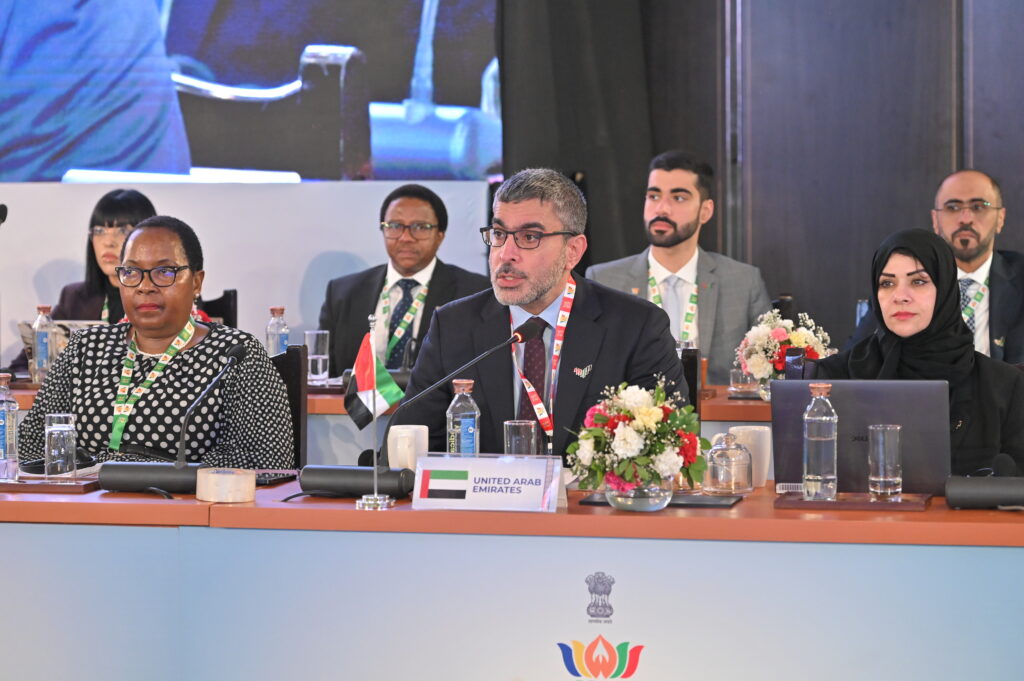
NEW DELHI, 26th June, 2026 (WAM) — Eng Sharif Al Olama, Undersecretary for Energy and Petroleum Affairs at the UAE Ministry of Energy and Infrastructure, led the UAE delegation to the BRICS Energy Ministers’ Meeting, hosted by India. The meeting brought together energy ministers and heads of delegations from BRICS member states to discuss enhancing cooperation in energy security, energy transition, innovation, and emerging technologies.
The UAE’s participation reflects its longstanding commitment to multilateral cooperation, strengthening international partnerships, and contributing actively to the development of shared solutions to global challenges. It also reinforces the country’s position as a trusted partner in building a more secure, sustainable, and resilient global energy system, while supporting international efforts to advance sustainable development and strengthen energy security.
During the meeting, Al Olama delivered the UAE’s national statement and participated in the launch of the BRICS Digital Centre of Excellence for Smart Grids and Energy Storage, an initiative aimed at enhancing cooperation among member states in digitalization, smart grid technologies, energy storage solutions, capacity building, and knowledge exchange.
The UAE’s participation in launching the Centre reflects its commitment to supporting international initiatives that promote knowledge sharing, accelerate the development of advanced technological solutions, and strengthen institutional capabilities. The initiative is expected to contribute to the transition towards more efficient and sustainable energy systems while enhancing collaboration among BRICS countries in future-focused priority areas.
Speaking during the Centre’s inaugural session, Al Olama emphasised that energy security is no longer defined solely by the availability of resources, but increasingly by the resilience of energy systems, their ability to adapt, and their integration of digital technologies, artificial intelligence, and energy storage solutions.
He also highlighted Abu Dhabi’s flagship clean energy project currently under development, which is set to become the world’s largest 24/7 renewable energy project. The project combines a 5.2 GW solar power facility with a 19 GWh battery energy storage system, demonstrating the UAE’s leadership in developing reliable and scalable clean energy solutions that support global energy security and transform innovation into strategic projects with worldwide impact.
In the UAE’s statement to the ministerial meeting, Al Olama stressed that the global energy transition requires stronger international cooperation, accelerated innovation, and the development of practical solutions that ensure energy remains secure, sustainable, and affordable. He noted that these efforts align closely with the historic UAE Consensus, adopted at COP28, which serves as a global roadmap for accelerating the transformation of energy systems and advancing climate neutrality goals.
Moreover, Al Olama welcomed the outcomes endorsed by the ministers, including the Guidelines for Smart Grids and Energy Storage, the Terms of Reference for the BRICS Platform for Energy Research Cooperation, the BRICS Hydrogen Value Chains Report, and the BRICS Energy Ministerial Communiqué.
He noted that these deliverables provide a practical framework for strengthening technical and research cooperation, promoting knowledge exchange, and accelerating the adoption of innovative solutions among member states.
The meeting also witnessed the launch of the BRICS Hydrogen Value Chains Report, to which the UAE made significant contributions through the BRICS Energy Working Group. One of the key deliverables of India’s BRICS Presidency, the report presents a shared vision for advancing cooperation in the hydrogen economy, encouraging investment and innovation, and developing integrated value chains for low-emission hydrogen.
Al Olama noted that the report reflects the lasting impact of COP28 outcomes and builds on the momentum generated by the UAE Consensus, which has helped guide international efforts to accelerate the deployment of low-emission technologies, including hydrogen. He highlighted the Consensus’ goals of tripling global renewable energy capacity and increasing the annual rate of energy efficiency improvements from around 2% to more than 4% by 2030.
He also highlighted the Hydrogen Declaration, endorsed by 39 countries during COP28, as a significant step towards harmonizing regulatory frameworks and promoting mutual recognition of hydrogen certification schemes. This, he noted, will support the development of trusted global markets for low-emission hydrogen, stimulate investment, and facilitate international trade in this promising sector.
Al Olama further outlined the UAE’s efforts to implement the National Hydrogen Strategy 2050 through the development of a comprehensive hydrogen ecosystem encompassing production, transportation, storage, and industrial applications. These efforts are designed to strengthen the UAE’s position as a global hub for the production and export of low-emission hydrogen while supporting the objectives of the UAE Consensus.
He also reaffirmed the UAE’s commitment to advancing universal access to sustainable energy, highlighting the country’s renewable energy investments in more than 70 countries worldwide. He further referenced the launch of the Global Energy Efficiency Alliance, aimed at strengthening international cooperation, facilitating knowledge exchange, building capacities, and accelerating progress towards the global target of doubling the rate of energy efficiency improvements by 2030.
During the meeting, the UAE reiterated its commitment to working closely with its BRICS partners to advance a cooperative approach based on dialogue, knowledge exchange, and joint initiatives that support global energy security, promote sustainable development, and address the rapidly evolving challenges facing the energy sector.
Concluding his remarks, Al Olama emphasised that the future of energy will be shaped by collaboration, innovation, effective partnerships, and mutual benefit. He reaffirmed the UAE’s support for the BRICS Energy Ministerial Communiqué and its readiness to continue working with all member states to strengthen energy security, accelerate innovation, and translate the outcomes of the UAE Consensus into practical initiatives and projects that advance sustainable development and enhance global energy security.
Source: Emirates News Agency