

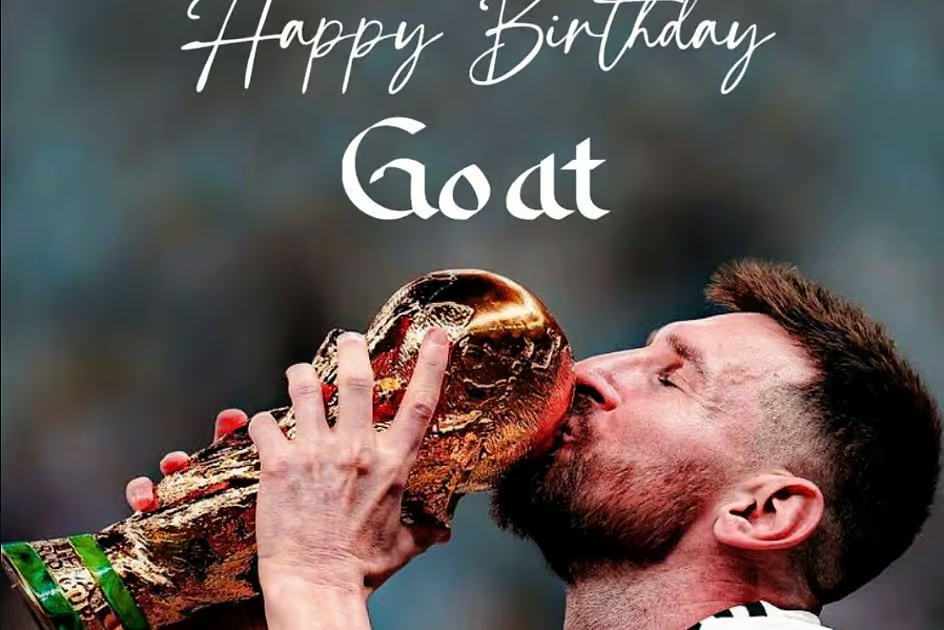
With the man-of-the-match trophy in his hands after his stunning display against Austria, Lionel Messi offered a tired smile when the television presenter asked him which of his record 18 World Cup goals was his favourite.
“I can’t remember. I am too tired now,” said Messi, who made his World Cup debut in 2006.
Today, Messi has turned 39 — he is now one of the oldest players to have played in a World Cup.
But the Argentine magician is still playing football with the same exuberance of a child.
To celebrate this supreme football artist, we are presenting you with five lesser-known pieces of trivia from his early days.
When did his football journey start?
Messi, who was born in 1987, was only four when he started playing for local club Abanderado Grandoli in Rosario, his hometown. His first coach was his father, Jorge. Messi had a beautiful affection for the ball, playing every day with his brothers, Rodrigo and Matías, and his cousins, Maximiliano and Emanuel Biancucchi. Messi’s favourite club in his childhood was Newell’s Old Boys. Messi, who now plays club football for Inter Miami, has often stated that he would want to finish his career by playing one season for Newell’s Old Boys, the famous club from Rosario.
Who was his first fan?
While his father was his first coach, it was his maternal grandmother, Celia Oliveira Cuccittini, who was his first big fan. Celia accompanied Messi to all matches at the sub-junior level. She even fought with the manager of the Abanderado Grandoli club, who was initially reluctant to let Messi play with the bigger and older boys. The manager eventually agreed, and Messi scored two goals, dribbling past several defenders. Stunned by his talent, the manager asked Celia to buy a proper football kit for her grandson.
The story behind Messi’s celebration
To this day, Messi celebrates every goal by raising both arms, pointing to the sky. Grateful to his grandmother’s influence in his early life as a footballer, Messi always makes it a point to honour her after scoring a goal. Celia didn’t get to see Messi grow into a legendary footballer as she passed away in 1998 at the age of 67. Five years after her death, Messi made his Spanish league debut for Barcelona. Two years later, in 2005, he led Argentina to the FIFA Under-20 World Cup title.
Trapped in a washroom
According to his mother, Celia Cuccittini, Messi was once trapped in a washroom at a local stadium during a junior tournament. He shouted for help, but nobody could hear him. Eventually, the little boy escaped by breaking the glass in the door. His team was losing 2-0 in the 70th minute of the match when he arrived. The coach brought him on immediately, and Messi went on to score a hat-trick in 20 minutes to earn a 3-2 win for his team and the man-of-the-match award.
First contract on a napkin
Messi was diagnosed with growth hormone deficiency. As a result, he was not growing normally like the children of his age, threatening to end his dream of becoming a professional footballer. When Messi’s family realised that the treatment for the disease was very expensive, they approached several big clubs in Argentina. But none of them agreed to pay for the treatment. It was then, in 2000 to be precise, that Messi’s father took him to Spain for a trial at FC Barcelona. In the trial game, Messi scored five goals against bigger boys in an astonishing display. But his father insisted that to get his son, Barcelona must pay for the treatment — otherwise he would approach other big clubs, including Real Madrid. Seeing his father’s frustration, Barcelona’s then sporting director Carles Rexach wrote an agreement on a paper napkin, promising to sign the young Argentine. The formal contract was signed a few days later, but the paper napkin has now become a part of football folklore. In February 2024, the napkin was sold at an auction for £762,400.
Source: Khaleej Times