

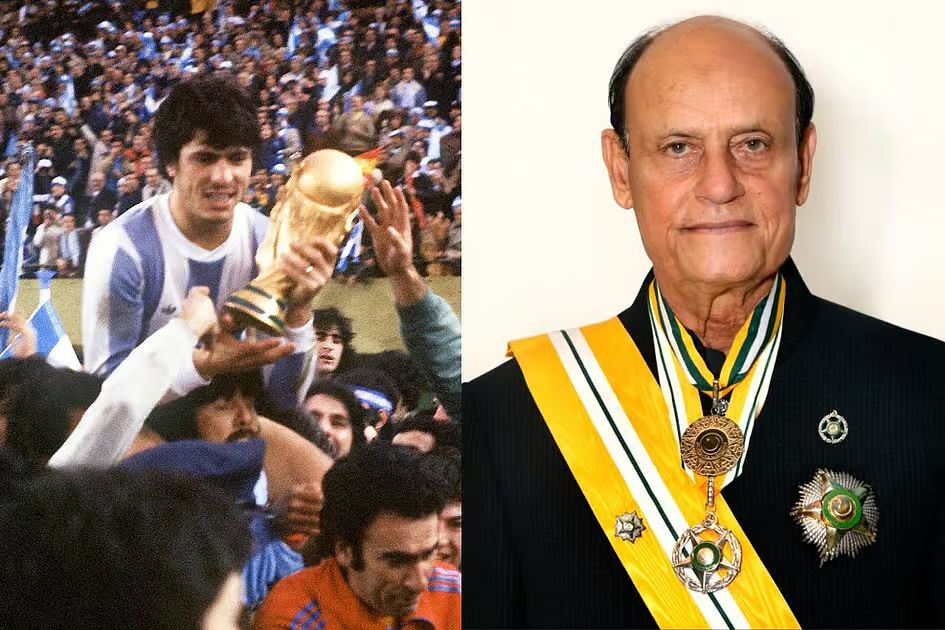
It was a striking coincidence that Lionel Messi delivered a record-breaking performance against Austria on Monday (June 22) — the day Argentina was celebrating the 40th anniversary of Diego Maradona’s iconic ‘Hand of God’ and the ‘Goal of the Century’ against England in the 1986 World Cup.
Messi’s two brilliant goals, which took his World Cup tally to 18, surpassing Miroslav Klose’s all-time record, have now kept the Argentine dream alive of winning their fourth title on football’s biggest stage.
But there was another striking coincidence — Pakistan’s second Hockey World Cup title and Argentina’s maiden World Cup football triumph came in the same year (1978) and in the same country (Argentina).
But more than the coincidence, there was an intriguing connection between Pakistan’s hockey win and Argentina’s first football success on the global stage.
It was Pakistan’s eye-catching hockey in their victorious run that inspired Argentina’s football team to make a tactical switch — one that played a big role in their victory.
So how did Pakistan’s hockey team inspire Argentina’s football squad?
Media attention
Two months before the start of the football showpiece, Argentina hosted the Hockey World Cup (March 19-April 2) in Buenos Aires.
With a star-studded team, Pakistan played a magical brand of hockey, seamlessly blending attack with defence to captivate the fans and the local media.
Pakistan’s scintillating style also caught the attention of Cesar Luis Menotti, the Argentina football coach who was preparing his team for the World Cup on home soil.
Menotti belonged to the old school of Argentinian football that drew inspiration from creative midfielders who launched waves of attacks on the rival defence.
But in a tournament featuring Brazil, West Germany, Italy and the Netherlands, the heavyweights, Menotti knew he needed to find the balance between attack and defence to launch a serious title bid.
Under incredible pressure to deliver the country’s first World Cup, Menotti was exploring the full range of tactics and formations when the media’s celebration of Pakistan’s glorious style of hockey captured his attention.
‘Vamos Pakistan’
It was Islahuddin Siddiqui, the legendary winger, who led the Pakistan team to the 1978 World Cup triumph.
Siddiqui is now 78, but he still vividly remembers how his team captivated Argentina’s sports lovers.
“We arrived in Argentina about two weeks before the Hockey World Cup in 1978 to acclimatise to the weather and playing conditions. We played a few practice matches, and there was a lot of attention from the local media, which regarded Pakistan as the big favourites to win the tournament,” Siddiqui told the Khaleej Times over the phone from San Francisco, where he is holidaying.
Argentina’s hockey lovers were curious about the Pakistan team after the extensive media coverage.
“They wanted to watch us play. So when the tournament began, our matches attracted the biggest crowds. The fans would chant, ‘Vamos Pakistan, Vamos Pakistan’,” Siddiqui recalled.
“Even in the match against Argentina (the home team), the fans chanted for us after half-time when we took a 4-0 lead. It was quite incredible for us because, apart from the staff at the Pakistan Embassy in Buenos Aires, there were virtually no Pakistanis living in Argentina at the time. Yet the support continued throughout our matches.”
The 5-3-2-1 formation
Pakistan went on to win the tournament emphatically, scoring 33 goals in eight matches while conceding just four.
It was that ability to defend resolutely while playing such attacking hockey that caught Menotti’s eye.
“The entire country was preparing for the football World Cup, and their coach — César Luis Menotti — was intrigued by our tactics,” he said.
“We were told that Menotti wanted to meet us and understand how we managed to maintain balance despite playing such an attacking brand of hockey.”
It was after a group stage game that Menotti met Siddiqui and members of the Pakistan coaching staff.
“We had a long conversation. I explained that we played with a 5-3-2-1 structure — five forwards, three half-backs, two full-backs and a goalkeeper. The system allowed us to attack without losing our defensive shape. It helped us exploit space, and opponents often struggled to cope with its flexibility,” Siddiqui said.
“Menotti listened very carefully, although at the time we had no idea whether he intended to apply any of those ideas to his football team.”
When the football World Cup began two months after the hockey tournament, Argentina played magical football with their creative flair and free-scoring style bringing the opponents to their knees.
In seven matches, they scored 15 goals, including three in the final against the formidable Netherlands team.
Captained by Daniel Passarella, Argentina conceded just four goals as they clinched the title, sparking wild celebrations across the country.
“What made it special was that after Argentina won the World Cup, Menotti publicly acknowledged our conversation about tactics,” Siddiqui said.
“According to Menotti, that tactical adjustment played a key role in Argentina’s World Cup triumph. For us, that was an enormous compliment.”
Menotti, who passed away in 2024, attained cult status in Argentina for guiding the national football team to World Cup glory.
“He was a very good man. You need a big heart to acknowledge another team and another sport in your greatest moment,” Siddiqui said.
“That experience created a special bond for me. Ever since then, I have been a supporter of Argentina at the World Cup.”
Source: Khaleej Times