

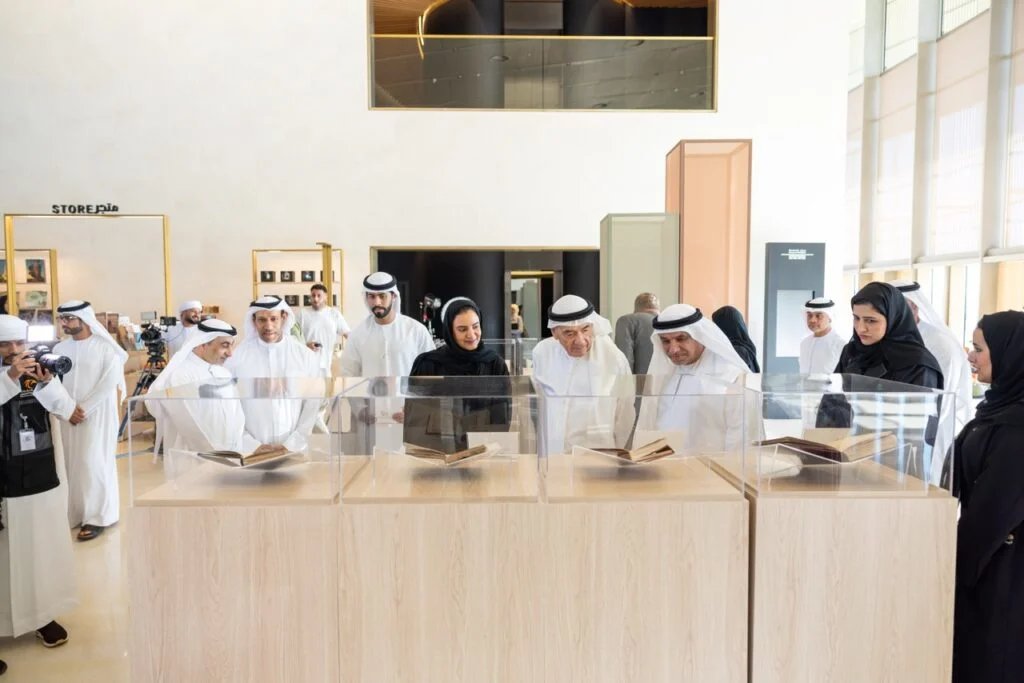
SHARJAH, 17th June, 2026 (WAM) — A collection of rare manuscripts spanning centuries of scientific inquiry, scholarship and cultural exchange has gone on display at the House of Wisdom (HoW) in Sharjah as part of the Manuscripts Exhibition – Sustainable Identity and Development, organised in collaboration with United Arab Emirates University (UAEU).
Part of UAEU’s Golden Jubilee celebrations, the exhibition builds on a nationwide cultural tour of one of the university’s most valuable collections. Through leading cultural venues across the UAE, the initiative highlights the role manuscripts have played in preserving and documenting these civilisations.
Running until 26 June, the exhibition showcases the enduring value of Arab and Islamic manuscripts as repositories of knowledge that have preserved scientific heritage, documented intellectual achievements, and carried learning across generations.
Zaki Anwar Nusseibeh, Cultural Advisor to the UAE President and Chancellor of UAEU, attended the opening, alongside Marwa Al Aqroubi, Executive Director of HoW; Prof. Ahmed Ali Al Raeesi, Vice Chancellor of UAEU; Prof. Ali Hilal Al Naqbi, Chancellor of the University of Khorfakkan; Dr. Tod Laursen, Chancellor of American University of Sharjah (AUS); as well as UAEU students, distinguished guests, and researchers and enthusiasts of scientific and cultural heritage.
The exhibition features fifty rare manuscripts from UAEU’s collections, spanning multiple fields. The collection features a diverse selection of manuscripts, treatises, and scholarly works that played a significant role in shaping Arab and Islamic civilisation across a wide range of disciplines, including the Holy Qur’an and Qur’anic studies, Arabic language and literature, astronomy, medicine, engineering, mathematics, and other scientific fields.
Organised around three themes, it highlights the breadth of scholarship that flourished. The first explores Quranic studies and the Arabic language; the second examines astronomy, geography, and timekeeping, showcasing Arab and Muslim contributions to the study of the universe; and the third focuses on theoretical and applied sciences, including medicine, mathematics, engineering, chemistry, and agriculture.
The exhibition takes visitors on an intellectual journey spanning nearly five centuries of scientific and scholarly achievement, highlighting the interconnectedness of diverse fields of knowledge and their contributions to societal advancement. It also offers a rare opportunity to explore the history of authorship, manuscript copying, and learning, and to discover the ideas and innovations that enriched human civilisation. Through this journey, the exhibition underscores the central role of knowledge in shaping both human development and civilisation across the ages.
Source: Emirates News Agency