

The atmosphere was thick with tension outside the Doha Exhibition & Convention Center. It was around 2:45 am on December 18, 2022, when a middle-aged Argentinian man made a last-ditch attempt to get tickets for the World Cup final.
Play and predict your Fifa World Cup 2026 champion here
It was barely 17 hours before the kick-off, and the sense of desperation was unmistakable on the Argentinian’s face when a young man, who seemingly possessed a bundle of tickets in his pocket, demanded $5,000 for each ticket.
Draped in the famous blue-and-white stripes of Argentina, the man nervously turned to his sons who sat on a bench, looking at their father with hope — both too young to comprehend the mighty challenge of finding seats at the Lusail Stadium.
As the Argentinian paused for a moment before making a phone call, the young man with tickets appeared before the two boys, this time with a ball at his feet, challenging them to a game of keepie-uppies.
“Messi’s no good, bro. Cristiano Ronaldo is the man,” he teased them before starting to show his impressive step-over skills as the two young boys watched in awe.
I could not bear to watch the boys and their helpless father any more and slowly made my way to the nearest metro station to catch the last train when someone called me, “hey bro, listen”.
I turned around and saw two Peruvian brothers I had met at Al Bayt Stadium a week before. Peru had not qualified for the Qatar World Cup, but the two brothers, Marco and Allan, had come all the way to support their other favourite team from South America, Brazil.
They asked me if I could help them with tickets for the final.
“Do you guys still want to watch the final? Brazil lost in the quarterfinals, right?” I asked.
“Of course, we want to watch the final for Messi. We want Argentina to win because of Messi,” Marco responded.
All I could do was wish them ‘good luck’.
But I was beginning to wonder if I would come across more fans desperate for tickets in the heart of Doha.
I headed back to my Airbnb, hoping to get a couple of hours of sleep before I could return to the Doha Exhibition & Convention Center — Fifa’s official ticketing centre for the Qatar World Cup.
The final was, of course, sold out. When I returned, it was 11 am, just nine hours before the kick-off. But the whole place was teeming with fans from Argentina, Mexico, China, Iran, India and many more countries — all hoping against hope to find someone who might sell his ticket.
When I approached a Mexican fan, Roberto Aguilar, for an interview, he refused to be photographed.
“Oh, I told my boss that I am attending my cousin’s wedding. Now if you put my picture up on your website and he finds out that I have come to Qatar to watch Messi, I don’t think he is going to be very happy about it,” the Mexican smiled.
A few feet away, a young Chinese fan, Li, was pleading for a ticket with the same young man who had demanded $5,000 from the Argentinian fan in the early morning.
As he kept negotiating with the man, I bumped into a group of French fans. I thought, ‘Here you go’ — finally some French fans for a World Cup final featuring the French team!’
In that group of French fans were Herve, and his father, Yohann, with both hoping to see their team win.
But Herve revealed that many fans in France would not be sad if Messi won the World Cup.
“He is big in France. I think many people in France will be happy if he wins today,” Herve said with a smile on his face.
I knew the magnitude of the occasion — a World Cup final between Argentina and France, two proud football nations bracing for the biggest battle of their lives.
But when a supporter says his own country would not be devastated if the rival team won a match as big as the World Cup final just because they admire the star player of that team, and when ticketless fans from so many different countries flew to Doha to support that same player, you knew you were witnessing someone whose impact had transcended all boundaries of sports.
That was the first day I realised that Messi was not just a football icon any more.
The Mexican fan, Roberto Aguilar, who had refused to be photographed, only reinforced my belief.
“There are (Diego) Maradona fans in Mexico. I heard that there is a church built by Maradona fans in Mexico in his honour. But they are just being Maradona fans. These people are like Maradona himself. They are extreme,” he said, referring to Maradona’s history of cocaine addiction.
“But, on the other hand, there is so much to admire about Messi as a person. We love him in Mexico. And we all want him to win, and that’s why I am here (in Doha). I don’t have the final ticket. But I wanted to be here to cheer for him even from outside the stadium.”
To this day, I don’t know whether Aguilar managed to get a ticket to witness Messi and Argentina’s famous win in the nerve-racking final against France on penalties, which ended the football-obsessed South American nation’s 36-year wait for their third World Cup trophy.
It was Messi’s first after years of heartbreak on the big stage.
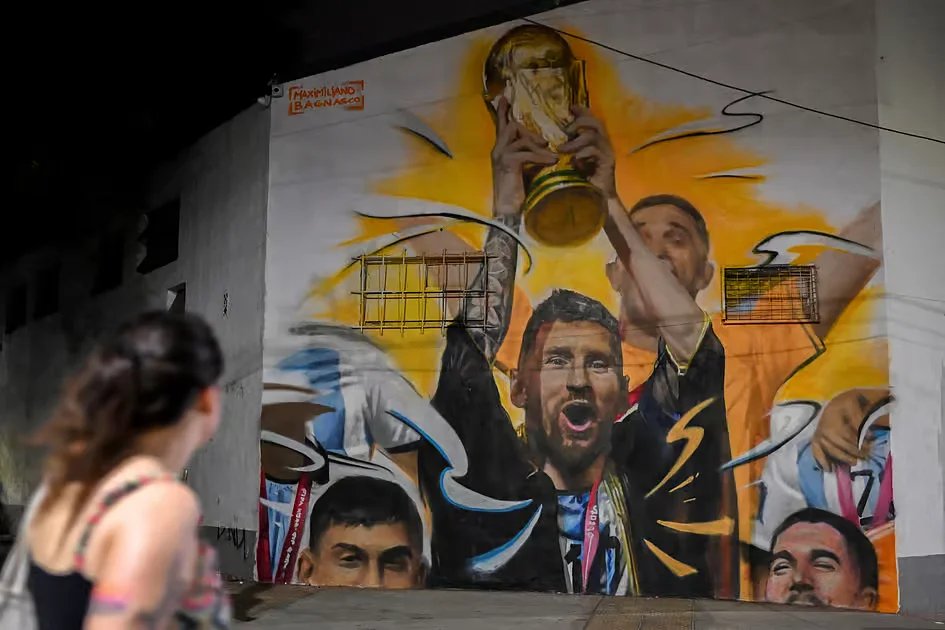
But from the Lusail Stadium media tribune, when I saw Messi caressing the trophy like a mother holding her newborn for the first time, I wondered whether winning the World Cup was the biggest victory of his life.
At that moment, the images of the Peruvian brothers pleading with me for tickets and a Mexican fan — Roberto Aguilar — boarding a flight to Doha without a match ticket came flooding back.
As I was walking out of the stadium, thousands of flag-waving Argentinian fans were singing with tears of joy rolling down their faces.
A group of fans emerged from one of the stadium exits, looking at the Argentinians dancing and singing their hearts out.
I asked them if they were from Argentina.
“No,” one of them replied.
“My name is Alejandro, I am from Mexico,” he said.
“I came here to support Messi with my parents and our Brazilian friend, Danilo.”
Remarkably, Alejandro said even Danilo was cheering for Argentina in the final.
As someone who has followed World Cup rivalries for close to four decades, I was taken aback by that revelation because a Brazilian wishing for an Argentina victory in a World Cup final is akin to expecting tropical weather in Siberia.
“Argentina-Brazil is the biggest football rivalry,” Alejandro admitted. “Even Mexico is a big rival for Argentina in football. But we all love Messi. That’s why we wanted Argentina to win.”
As many anticipated, Messi didn’t retire with the World Cup trophy in his hands.
Now, almost four years later, the ageing magician has arrived in North America for his sixth World Cup appearance, hoping to inspire Argentina to become the first team since Brazil in 1962 to defend the title.
Winning the tournament again for Argentina at the age of 38 is likely to be an impossible mission for Messi.
The defending champions, who open their campaign against Algeria on Wednesday (5 am UAE Time), will nevertheless hope for some more inspiration from their talisman.
Recovering from hamstring fatigue, Messi can still produce moments of magic on the field.
But it’s his magnetic appeal that has defied belief.
Pele won more World Cups, and Maradona produced the greatest individual performance the tournament has ever seen.
But none of them could claim to possess Messi’s rare ability to draw cheers from the rival fans on football’s biggest stage.
Source: Khaleej Times