

Imagine growing up in a world where altering your looks is available at the click of a button. Want to look skinny? Use a slimming app. Don’t like your features? Use an AI edit. Too dusky? Lighten your skin tone. Got blemishes? Airbrush the photo. These Photoshop-esque features are so easily available and deeply normalised today that one rarely stops to assess the negative body image they propagate in teenagers growing up under the pressure to look “perfect” on social media.
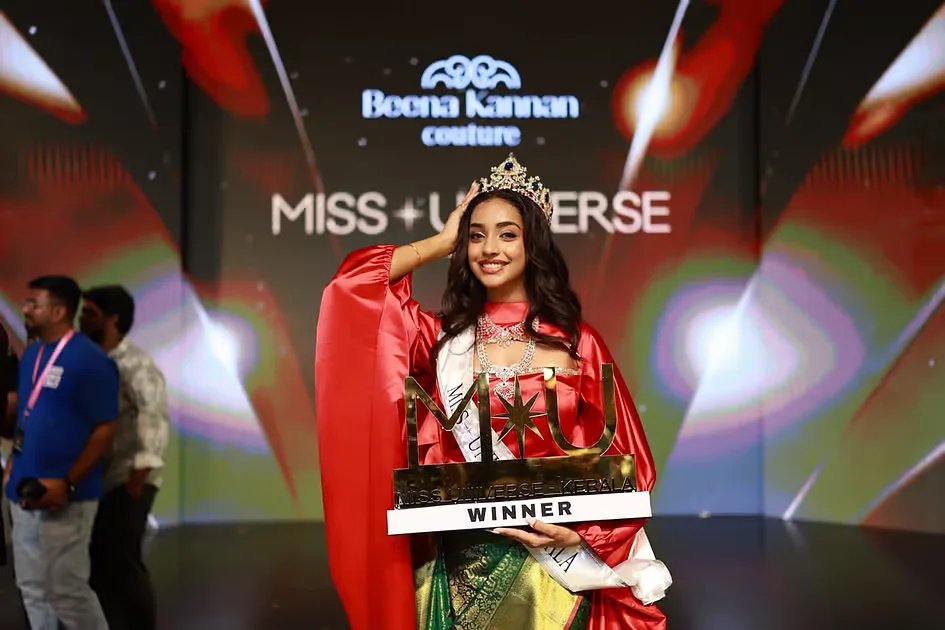
For 19-year-old Kaziah Liz Mejo, the newly crowned Miss Universe Kerala, this digital distortion became a lived reality. Before standing under the glittering lights of the pageant stage as a symbol of youth and confidence, Kaziah spent years navigating the exhausting maze of teenage insecurity and body dysmorphia, a struggle deeply intertwined with her adolescent years.
But confidence did not always feel so elusive. Growing up in Abu Dhabi, Kaziah was an extroverted and self-assured child. “I was constantly switching schools,” she recalls, charting a journey from Emirates National School to the all-girls St. Joseph’s and finally to the Abu Dhabi Indian School for her senior years. “But one thing I constantly felt was always at home. That’s something that I really appreciate about the country.”
In the quieter Abu Dhabi of the late 2000s, a young Kaziah found her initial footing on the stage. Enrolled in classical dance lessons and local “baby shows” by her mother, she possessed an innate, unfiltered wit. “When you’re a kid, there’s no aspect of insecurity,” Kaziah adds. “All you know is to have fun, get dressed in pretty dresses and show the world what your favourite cartoon is.”
The filter trap
The transition into her teenage years, however, introduced a stark shift. The natural friction of moving between schools was compounded by the toxic beauty standards of the digital age.
“For three years of my life, and I kid you not, I did not have a single picture of myself without some sort of filter,” Kaziah admits. Even though these were the whimsical, cat-eared overlay filters popular on social media, they were still designed to narrow the face, enlarge the eyes and artificially alter skin tones.
For a young girl with a naturally duskier complexion, the digital landscape often felt unforgiving. “I was very, very insecure about my skin tone. Growing up, you see advertisements for fairness creams and you see your favourite influencers promoting them, and then you start feeling like, ‘Okay, I was built wrong.’”
An inherent extrovert, Kaziah began to question whether her outspoken personality was “too much” for social settings. “I started taking up less space. I started hiding myself and hiding who I truly was from the world because I thought I wouldn’t be accepted.”
Navigating this phase of body dysmorphia was a solitary battle, largely hidden from her traditional Malayali parents who, at the time, viewed teenage troubles as something a quick trip outside could fix.
The audacity to dream big
The turning point for Kaziah came from an intentional check-in with herself and a refusal to bow down to societal conventions. A philosophy she describes with a smile as staying deliberately “unrealistic” or, in Gen-Z slang, being “delulu”.
As a child, her mother encouraged her to write her ambitions in a notebook. Kaziah filled the pages with wild, un-tempered dreams, including a wish to be on the Hollywood Walk of Fame. “I’m just a regular 13-year-old in Abu Dhabi who has no connections. I’d think to myself, ‘Oh my god, I need to calm down and think of something practical.’ But the audacity to dream big is what got me here today. If you stay practical, you’re going to limit yourself before you even try.”
This willingness to risk failure was put to the test when she entered the international teen pageant circuit and finished as first runner-up, a result that initially left her questioning her path forward.
Yet, it was that exact detour that allowed her to recalibrate for the Miss Universe Kerala platform. “A winner is just a loser who tried one more time,” she adds. “When you ask God for a flower and you don’t get it immediately, you don’t realise that it’s because He’s watering a whole garden for you.”
‘Social media is fake’
Now holding the title, Kaziah is acutely aware of the paradox of her position. Operating within an industry historically criticised for promoting rigid beauty standards, the 19-year-old is conscious of the responsibility to remain an authentic role model for young girls facing the same digital pressures she once did. “Social media is so fake. Imagine those kids who are not even confident. If we promote that fake idea, then what kind of example are we setting?”
Her rebellion against this perfectionism manifests in her refusal to perform the standard pageant lifestyle. “I don’t have a diet,” she says, countering the curated ‘What I Eat in a Day’ salad videos that dominate influencer feeds. “After every single shoot, the way I treat myself is with McDonald’s. If you’re restricting yourself from these simple joys of life, what are you even doing?”
Instead, she advocates for an intuitive understanding of one’s own body and genetics. “As Malayalis, we genetically have a little bit of a tummy because our constant meal is rice. These are things that you need to understand, you can’t just be so blindsided by what you see on social media.”
Home is where the heart is
Currently balancing the intense academic rigour of a law degree in Bengaluru, studying case law on her iPad between pageant rehearsals, Kaziah views her identity as a bridge between the diaspora and the homeland. Moving back to India independently at age 17 was a deliberate choice to ground her representation in the everyday realities of the country.
“Sometimes when you’re living abroad, you are made to feel like you’re not Indian enough. Then other times, you’re made to feel like you’re not Arab or local enough,” she adds. “But being Indian is more than just geography, it’s the morals and values that you carry within you.”
Though commitments keep her from visiting her family in the UAE frequently, her nostalgia for Abu Dhabi remains tied to simple childhood comforts — the craving for an authentic local shawarma and the ritual she shared with her sister, now an actress and medical student in Georgia, of diving into kilos of mixed grills from Sultan.
And when she finally does return to the capital, all the pageantry glam will be temporarily paused for a much simpler joy. “The first thing I have to say is have podichor,” she laughs, explaining the ultimate comfort of rice and curries wrapped in a banana leaf. “And my mom has to feed me, I refuse to eat it by myself!”
Source: Khaleej Times