

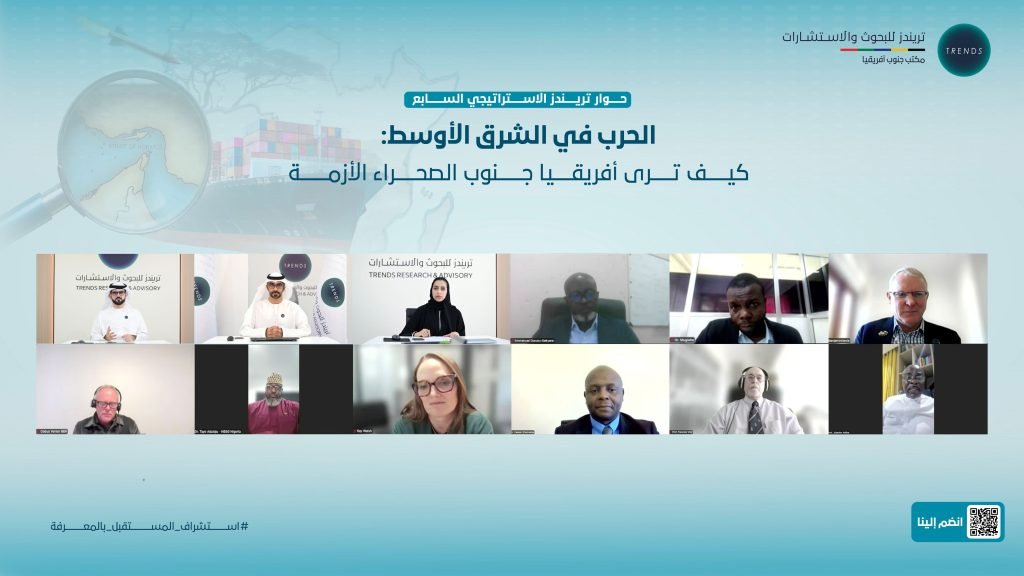
ABU DHABI, 19th April, 2026 (WAM) — Participants in the Seventh Strategic Dialogue, organised by TRENDS Research & Advisory through its South Africa office, titled The War in the Middle East: How Sub-Saharan Africa Sees the Crisis, recommended strengthening regional cooperation within Africa as a central tool to enhance collective capacity to absorb external shocks and coordinate positions in international forums related to security and development.
They emphasised the need to adopt a proactive approach to managing geopolitical risks by integrating major regional transformations into economic and security planning policies in Sub-Saharan African countries, rather than treating them as emergency crises.
They also stressed the importance of diversifying international partnerships to reduce reliance on single centers of influence and strengthen African countries’ ability to negotiate within a more balanced and flexible global environment.
They further emphasised the need to invest in economic resilience, particularly in the energy and food sectors, by developing more stable local and regional supply chains and reducing exposure to volatile external markets. In addition, they called for a more effective African role in international discussions on regional security to ensure that global decisions reflect development and economic justice rather than solely traditional power balances.
The dialogue brought together a distinguished group of experts, economic analysts, and researchers. It was opened by Abdulaziz Al Marzouqi, a researcher at TRENDS.
This was followed by the economic panel discussion, moderated by Ben Davis, Director of the TRENDS South Africa Office. The session began with remarks by Dr. Tayo Aduloju, CEO of the Nigerian Economic Summit Group (NESG). Cobus Venter, Senior Consulting Economist at the Bureau for Economic Research (BER) in South Africa, explained that South Africa’s economy is small, highly open, and resource-rich.
The panel was attended by Kay Walsh, CEO of Nova Economics in South Africa, Dr. Mugisha Rweyemamu of the Economic and Social Research Foundation (ESRF), and Dr. Emmanuel Owusu-Sekyere, Director of Research, Policy and Programmes at the Africa Center for Economic Transformation.
The discussion then shifted to the international relations panel, moderated by Najla Al Midfa, a researcher at TRENDS. The panel was attended by Professor Francois Vrey, a maritime and regional security specialist at the Security Institute for Governance and Leadership in Africa (SIGLA), Prof. Jideofor Adibe of Nasarawa State University in Nigeria, and Dr. Hassan Khannenje, Executive Director of the HORN International Institute for Strategic Studies in Kenya.
In the closing remarks, Hamdan Al Hamdani, a researcher at TRENDS, stated that the in-depth discussion of African perspectives on the Middle East war is highly significant for exploring post-war scenarios and reshaping regional and international alliances and understandings.
He added that the world is at a pivotal moment, reshaping the maps of influence and bilateral and multilateral relations, requiring a rethinking of the relationship between regional security and global stability, particularly in Sub-Saharan Africa.
He added that the interventions highlighted that this crisis cannot be reduced to its military, political, and strategic dimensions affecting its direct parties or regional surroundings; rather, it extends to encompass economic, humanitarian, and developmental impacts in distant regions. The effects of the war are also evident in disruptions to supply chains, rising energy and food costs, and the increasing vulnerability of developing economies to external shocks.
Source: Emirates News Agency